Econometrics, economics, finance, random rants.

Econometrics, economics, finance, random rants...
Showing posts with label Econometrics History. Show all posts

Sunday, September 23, 2018

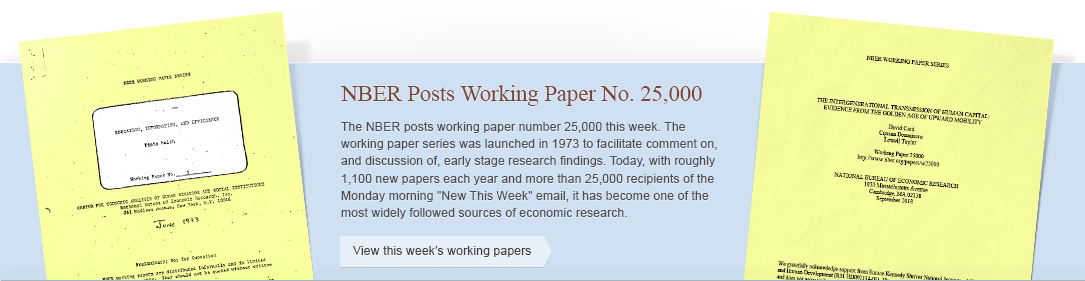
NBER WP's Hit 25,000


A few weeks ago the NBER released WP25000, What a great NBER service -- there have been 7.6 million downloads of NBER WP's in the last year alone. 


This milestone is 
of both current and historical interest. The history is especially interesting. As Jim Poterba notes in a recent communication:
This morning's "New this Week" email included the release of the 25000th NBER working paper, a study of the intergenerational transmission of human capital by David Card, Ciprian Domnisoru, and Lowell Taylor.  The NBER working paper series was launched in 1973, at the inspiration of Robert Michael, who sought a way for NBER-affiliated researchers to share their findings and obtain feedback prior to publication.  The first working paper was "Education, Information, and Efficiency" by Finis Welch.  The design for the working papers -- which many will recall appeared with yellow covers in the pre-digital age -- was created by H. Irving Forman, the NBER's long-serving chart-maker and graphic artist.
Initially there were only a few dozen working papers per year, but as the number of NBER-affiliated researchers grew, particularly after Martin Feldstein became NBER president in 1977, the NBER working paper series also expanded.  In recent years, there have been about 1150 papers per year.  Over the 45 year history of the working paper series, the Economic Fluctuations and Growth Program has accounted for nearly twenty percent (4916) of the papers, closely followed by Labor Studies (4891) and Public Economics (4877).

Saturday, September 15, 2018

An Open Letter to Tren Griffin

[I tried quite hard to email this privately. I post it here only because Griffin has, as far as I can tell, been very successful in scrubbing his email address from the web. Please forward it to him if you can figure out how.]

Mr. Griffin:

A colleague forwarded me your post, https://25iq.com/2018/09/08/risk-uncertainty-and-ignorance-in-investing-and-business-lessons-from-richard-zeckhauser/.  I enjoyed it, and Zeckhauser definitely deserves everyone's highest praise. 

However your post misses the bigger picture.  Diebold, Doherty, and Herring conceptualized and promoted the "Known, Unknown, Unknowable" (KuU) framework for financial risk management, which runs blatantly throughout your twelve "Lessons From Richard Zeckhauser".  Indeed the key Zeckhauser article on which you draw appeared in our book, "The Known, the Unknown and the Unknowable in Financial Risk Management", https://press.princeton.edu/titles/9223.html, which we also conceptualized, and for which we solicited the papers and authors, mentored them as regards integrating their thoughts into the KuU framework, etc.  The book was published almost a decade ago by Princeton University Press. 

I say all this not only to reveal my surprise and annoyance at your apparent unawareness, but also, and more constructively, because you and your readers may be interested in our KuU book, which has many other interesting parts (great as the Zeckhauser part may be), and which
, moreover, is more than the sum of its parts. A pdf of the first chapter has been available for many years at http://assets.press.princeton.edu/chapters/s9223.pdf.

Sincerely,

Monday, April 16, 2018

The History of Forecasting Competitions

Check out Rob Hyndman's "Brief History of Time Series Forecasting Competitions". I'm not certain whether the title's parallel to Hawking's Brief History of Time is intentional. At any rate, even if Hyndman's focus is rather more narrow than the origin and fate of the universe, his post is still fascinating and informative. Thanks to Ross Askanasi for bring it to my attention.

Sunday, July 23, 2017

On the Origin of "Frequentist" Statistics

Efron and Hastie note that the "frequentist" term "seems to have been suggested by Neyman as a statistical analogue of Richard von Mises' frequentist theory of probability, the connection being made explicit in his 1977 paper, 'Frequentist Probability and Frequentist Statistics'".  It strikes me that I may have always subconsciously assumed that the term originated with one or another Bayesian, in an attempt to steer toward something more neutral than "classical", which could be interpreted as "canonical" or "foundational" or "the first and best".  Quite fascinating that the ultimate "classical" statistician, Neyman, seems to have initiated the switch to "frequentist".

Monday, November 28, 2016

Gary Gorton, Harald Uhlig, and the Great Crisis

Gary Gorton has made clear that the financial crisis of 2007 was in essence a traditional banking panic, not unlike those of the ninetheeth century.  A key corollary is that the root cause of the Panic of 2007 can't be something relatively new, like "Too Big to Fail".  (See this.)  Lots of people blame residential mortgage-backed securities (RMBS's), but they're also too new.  Interestingly, in new work Juan Ospina and Harald Uhlig examine RBMS's directly.  Sure enough, and contrary to popular impression, they performed quite well through the crisis.

Tuesday, May 17, 2016

Statistical Machine Learning Circa 1989

I've always been a massive fan of statisticians whose work is rigorous yet practical, with emphasis on modeling. People like Box, Cox, Hastie, and Tibshirani obviously come to mind.  So too, of course, do Leo Brieman and Jerry Friedman.  

I had the good luck to stumble into a week-long intensive lecture series with Jerry Friedman in 1989, a sort of summer school for twenty-something assistant professors and the like.  At the time I was a young economist in DC at the Federal Reserve Board, and the lectures were just down the street at GW.

I thought I would attend to learn some non-parametrics, and I definitely did learn some non-parametrics.  But far more than that, Jerry opened my eyes to what would be unfolding for the next half-century -- flexible, algorithmic, high-dimensional methods -- the statistics of "Big Data" and "machine learning".  

I just found the binder containing his lecture notes.  The contents appear below.  Read the opening overview, "Modern Statistics and the Computer Revolution".  Amazingly prescient.  Remember, this was 1989!

[Side note:  There I also had the pleasure of first meeting Bob Stine, who has now been my esteemed Penn Statistics colleague for more than 25 years.]


Monday, May 9, 2016

On the Origin of "Forecasts"

The word forecasts, that is. From the BBC Magazine, http://www.bbc.com/news/magazine-32483678:
One hundred and fifty years ago Admiral Robert FitzRoy, the celebrated sailor and founder of the Met Office, took his own life. One newspaper reported the news of his death as a "sudden and shocking catastrophe". Today FitzRoy is chiefly remembered as Charles Darwin's taciturn captain on HMS Beagle, during the famous circumnavigation in the 1830s. But in his lifetime FitzRoy found celebrity not from his time at sea but from his pioneering daily weather predictions, which he called by a new name of his own invention - "forecasts".

And quite apart from the origin of the term, the description of the early development of weather forecasting is fascinating.

[Thanks to Glenn Rudebusch for bringing this to my attention.]


Thursday, May 5, 2016

Unsung Hero: NBER Conference on Research in Income and Wealth

Here's to the the NBER's ongoing Conference on Research in Income and Wealth (CRIW), unsung hero, home of down-and-dirty measurement mavens since 1935.  Yes, since 1935!  Check out Chuck Holten's fascinating CRIW description in the NBER Reporter, and the full list of associated CRIW volumes published. What a stunning record of steady service.

FYI a typical program (in this case, from last summer) appears below.


NATIONAL BUREAU OF ECONOMIC RESEARCH, INC. 
SI 2015 NBER/CRIW Workshop 
Susanto Basu, Nicholas Bloom, Carol Corrado and Charles R. Hulten, Organizers 
July 13-14, 2015 

Charles B Room
Royal Sonesta Hotel
40 Edwin H. Land Blvd.
Cambridge, MA

PROGRAM


Monday, July 13:
8:30 am
Continental breakfast
9:00 am
Thomas Piketty, Paris School of Economics
Emmanuel Saez, University of California at Berkeley and NBER
Gabriel Zucman, London School of Economics
Distributional National Accounts: Methods and Estimates for the United States Since 1913

Discussant: 
John Sabelhaus, Federal Reserve Board
10:00 am
Break
10:30 am
Jae Song, Social Security Administration
David J. Price, Stanford University
Fatih Guvenen, University of Minnesota and NBER
Nicholas Bloom, Stanford University and NBER
Till M. von Wachter, University of California at Los Angeles and NBER
Firming Up Inequality

Discussant:  
Johannes Schmieder, Boston University
11:15 am
Phillipe Aghion, Harvard University and NBERUfuk Akcigit, University of Pennsylvania and NBER
Antonin BergeaudBanque de France
Richard Blundell, University College London
David Hemous, INSEAD
Innovation and Top Income Inequality

Discussant: Scott Stern, Massachusetts Institute of Technology and NBER
12:00 pm
Lunch
1:00 pm
Wolfgang Keller, University of Colorado and NBER
Hale Utar, Bielefeld University
International Trade and Job Polarization: Evidence at the Worker Level

Discusant
David Autor, MIT and NBER
1:45 pm
Dongya Koh, University of Arkansas
Raul Santaeulalia-Llopis, Washington University in St. Louis
Yu Zheng, City University of Hong Kong
Labor Share Decline and the Capitalization of Intellectual Property Products

Discussant: Dan Sichel, Wellesley College and NBER
2:30 pm
Break
3:00 pm
3:30 pm
Muge Adalet McGowan, Organisation de Coopération et de Développement Économiques(OCDE)
Dan R. Andrews, Organisation de Coopération et de Développement Économiques(OCDE)
Labour Market Mismatch and Labour Productivity: Evidence from PIAAC Data
4:00 pm
Adjourn


Tuesday, July 14:
8:30 am
Continental breakfast
9:00 am
Carol Corrado, The Conference Board
Jonathan Haskel, Imperial College London
Cecilia Jona-Lasinio, LUISS University of Rome
Bilal Nasim, Institute of Education
Is International R&D Tax Competition a Zero-sum Game? Evidence from the EU 
Discussant: Bronwyn Hall, University of California, Berkeley and NBER
9:45 am
Antonio Falato, Federal Reserve Board
Jae Sim, Federal Reserve Board
Why Do Innovative Firms Hold So Much Cash? Evidence from Changes in State R&D Tax Credits

Discussant: Daniel Wilson, Federal Reserve Bank of San Francisco
10:30 am
Break
11:00 am
Neil Thompson, Massachusetts Institute of Technology
Moore’s Law goes Multicore: The Economic Consequences of a Fundamental Change in how Computers work

Discussant: Chris Forman, Georgia Institute of Technology
11:45 am
John Bai, University of Southern California
Daniel Carvalho, University of Southern California
Gordon Phillips, University of Southern California
The Impact of Bank Credit on Labor Reallocation and Aggregate Industry Productivity

Discussant: Javier Miranda, Census Bureau

12:30 pm
Lunch
Joint Session with Macro Productivity:
1:30 pm
Gita Gopinath, Harvard University and NBER
Sebnem Kalemli-Ozcan, University of Maryland and NBER
Loukas Karabarbounis, University of Chicago and NBER
Carolina Villegas-Sanchez, ESADE-Universitat Ramon Llull
Capital Allocation and Productivity in South Europe

Discussant: Diego Restuccia, University of Toronto

2:15 pm
Colin J. Hottman, Columbia University
Stephen J. Redding, Princeton University and NBER
David Weinstein, Columbia University and NBER
What is ’Firm Heterogeneity’ in Trade Models? The Role of Quality, Scope, Markups, and Cost

Discussant: Daniel Xu, Duke University and NBER

3:00 pm
Break

3:15 pm
Lucia Foster, Bureau of the Census
Cheryl Grim, Bureau of the Census
John C. Haltiwanger, University of Maryland and NBER
Zoltan Wolf, Center for Economic Studies, US Bureau of Census
Macro and Micro Dynamics of Productivity: Is the Devil in the Details?

Discussant: Jan De Loecker, Princeton University and NBER

4:00 pm
Adjourn

5:15 pm
Reception at the Royal Sonesta Hotel


Wednesday, March 30, 2016

Honoring Gregory Chow, Econometrics Pioneer

Wonderful to see this.  So many massive contributions. Structural change, optimal control, development, and much more.

New Issue for Frontiers of Economics in China (FEC)


F

Frontiers of Economics in China <fec@pub.hep.cn>


|
To:

Diebold, Francis X;

Tue 3/29/2016 9:02 PM
To help protect your privacy, some content in this message has been blocked. To re-enable the blocked features, click here.
To always show content from this sender, click here.

Full Text Available


Frontiers of Economics in China (FEC)


Dwight H. Perkins

Front. Econ. China. 2016, 11 (1): 1-6.   DOI: 10.3868/s060-005-016-0001-5

Abstract   PDF (71KB)


Zhiqi Chen

Front. Econ. China. 2016, 11 (1): 7-8.   DOI: 10.3868/s060-005-016-0002-2

Abstract   PDF (56KB)


Jushan Bai,Xu Han

Front. Econ. China. 2016, 11 (1): 9-39.   DOI: 10.3868/s060-005-016-0003-9

Abstract   PDF (311KB)


Yanqin Fan,Ruixuan Liu,Dongming Zhu

Front. Econ. China. 2016, 11 (1): 40-59.   DOI: 10.3868/s060-005-016-0004-6

Abstract   PDF (325KB)


Ming-Jen Chang,Ping Wang,Danyang Xie

Front. Econ. China. 2016, 11 (1): 60-87.   DOI: 10.3868/s060-005-016-0005-3

Abstract   PDF (3137KB)


Zili Yang

Front. Econ. China. 2016, 11 (1): 88-103.   DOI: 10.3868/s060-005-016-0006-0

Abstract   PDF (461KB)


Yongsheng Xu

Front. Econ. China. 2016, 11 (1): 104-122.   DOI: 10.3868/s060-005-016-0007-7

Abstract   PDF (375KB)


Ming Lei,Zihan Yin

Front. Econ. China. 2016, 11 (1): 123-141.   DOI: 10.3868/s060-005-016-0008-4

Abstract   PDF (186KB)


X. Henry Wang,Bill Z. Yang

Front. Econ. China. 2016, 11 (1): 142-155.   DOI: 10.3868/s060-005-016-0009-1

Abstract   PDF (327KB)


Yanrui Wu

Front. Econ. China. 2016, 11 (1): 156-172.   DOI: 10.3868/s060-005-016-0010-5

Abstract   PDF (283KB)


Frank H. Liu

Frontiers of Economics in China (FEC), Higher Education Press

F15, Fortune Tower 1, 4 Huixin East St., Chaoyang District, Beijing 100029, P. R. China

Tel:  010-58556312, 13911937357


Website: http://journal.hep.com.cn/fec

QQ: 3542958,  Wechat: FEC2006