
Showing posts with label Obituaries. Show all posts
Showing posts with label Obituaries. Show all posts
Monday, March 18, 2019
Alan Krueger RIP
Very sad to report that Alan Krueger has passed away. He was a tremendously gifted empirical economist, with a fine feel for identifying issues that were truly important, and for designing novel and powerful empirical strategies to address them.

Thursday, November 15, 2018
JFEC Special Issue for Peter Christoffersen
No, I have not gone into seclusion. Well actually I have, but not intentionally and certainly not for lack of interest in the blog. Just the usual crazy time of year, only worse this year for some reason. Anyway I'll be back very soon, with lots to say! But here's something important and timely, so it can't wait:
Journal of Financial Econometrics
Call for Papers
Special Issue in Honor of Peter Christoffersen
The Journal of Financial Econometrics is organizing a special issue in memory of Professor Peter
Christoffersen, our friend and colleague, who passed away in June 2018. Peter held the TMX Chair in Capital Markets and a Bank of Canada Fellowship and was a widely respected member of the Rotman School at the University of Toronto since 2010. Prior to 2010, Peter was a valued member of the Desautels Faculty of Management at McGill University. In addition to his transformative work in econometrics and volatility models, financial risk and financial innovation had been the focus of Peter’s work in recent years.
We invite paper submissions on topics related to Peter’s contributions to Finance and Econometrics. We are particularly interested in papers related to the following topics:
1) The use of option-implied information for forecasting; Rare disasters and portfolio
management; Factor structures in derivatives and futures markets.
2) Volatility, correlation, extreme events, systemic risk and Value-at-Risk modeling for
financial market risk management.
3) The econometrics of digital assets; Big data and Machine Learning.
To submit a paper, authors should login to the Journal of Financial Econometrics online submission system and follow the submission instructions as per journal policy. The due date for submissions is June 30, 2019. It is important to specify in the cover letter that the paper is submitted to the special issue in honor of Peter Christoffersen, otherwise your paper will not be assigned to the guest editors.
Guest Editors
• Francis X. Diebold, University of Pennsylvania
• René Garcia, Université de Montréal and Toulouse School of Economics
• Kris Jacobs, University of Houston
Journal of Financial Econometrics
Call for Papers
Special Issue in Honor of Peter Christoffersen
The Journal of Financial Econometrics is organizing a special issue in memory of Professor Peter
Christoffersen, our friend and colleague, who passed away in June 2018. Peter held the TMX Chair in Capital Markets and a Bank of Canada Fellowship and was a widely respected member of the Rotman School at the University of Toronto since 2010. Prior to 2010, Peter was a valued member of the Desautels Faculty of Management at McGill University. In addition to his transformative work in econometrics and volatility models, financial risk and financial innovation had been the focus of Peter’s work in recent years.
We invite paper submissions on topics related to Peter’s contributions to Finance and Econometrics. We are particularly interested in papers related to the following topics:
1) The use of option-implied information for forecasting; Rare disasters and portfolio
management; Factor structures in derivatives and futures markets.
2) Volatility, correlation, extreme events, systemic risk and Value-at-Risk modeling for
financial market risk management.
3) The econometrics of digital assets; Big data and Machine Learning.
To submit a paper, authors should login to the Journal of Financial Econometrics online submission system and follow the submission instructions as per journal policy. The due date for submissions is June 30, 2019. It is important to specify in the cover letter that the paper is submitted to the special issue in honor of Peter Christoffersen, otherwise your paper will not be assigned to the guest editors.
Guest Editors
• Francis X. Diebold, University of Pennsylvania
• René Garcia, Université de Montréal and Toulouse School of Economics
• Kris Jacobs, University of Houston
Thursday, October 4, 2018
In Memoriam Herman Stekler
I am sad to report that Herman Stekler passed away last month. I didn't know until now. He was a very early and important and colorful -- indeed unique -- personage in the forecasting community, making especially noteworthy contributions to forecast evaluation.
https://forecasters.org/herman-stekler_oracle-oct-2018/
https://forecasters.org/herman-stekler_oracle-oct-2018/
Friday, July 20, 2018
Remembering Peter Christoffersen
This is adapted from remarks read at a memorial service earlier this week:
I'm sad not to be able to be here in person, and I'm grateful to Peter Pauly for kindly agreeing to read these academically-focused remarks.
His reading is unusually wonderful and appropriate, as he played a key role in
my Ph.D. training, which means that if Peter
Christoffersen was my student, he was also Peter Pauly's
"grandstudent". For all that they taught me, I am immensely grateful
both to Peter Pauly in early years, and to Peter Christoffersen in later years.
I am also grateful to Peter Pauly for another reason -- he was the dean who
wisely hired the Christoffersens!
I have been fortunate to have had many wonderful students in
various cohorts, but Peter's broad cohort was surely the best: Peter of course,
plus (in alphabetical order) Sassan Alizadeh, Filippo Altissimo, Jeremy
Berkowitz, Michael Binder, Marcelle
Chauvet, Lorenzo Giorgiani, Frank Gong, Atsushi Inoue, Lutz Kilian, Jose Lopez,
Anthony Tay, and several others.
The Penn econometrics faculty around that time was similarly
strong: Valentina Corradi, Jin Hahn, Bobby Mariano, and eventually Frank
Schorfheide, with lots of additional macro-econometrics input from Lee Ohanian
and financial econometrics input from Michael Brandt. Hashem Pesaran also visited
Penn for a year around then. Peter was well known by all the faculty, not
just the econometricians. I recall that the macroeconomists were very
disappointed to lose him to econometrics!
Everyone knows Peter's classic 1998 "Evaluating
Interval Forecasts" paper, which was part of his Penn dissertation. He
uncovered the right notion of the "residual" for a (1-a) x 100%
interval forecast, and showed that if all is well then it must be iid
Bernoulli(1-a). The paper is one of the International
Economic Review's ten most cited papers since its founding in 1960.
Peter and I wrote several papers together, which I
consider among my very best, thanks to Peter's lifting me to higher-than-usual
levels. They most definitely include our Econometric
Theory paper on optimal prediction under asymmetric loss, and our Journal of Business and Economic Statistics
paper on multivariate forecast evaluation.
Peter's research style was marked by a wonderful blend of
intuition, theoretical rigor, and always, empirical relevance, which took him
to heights that few others could reach. And his personality, which simply radiated
positivity, made him not only a wonderful person to talk soccer or ski with, but the best imaginable person to talk research with.
Peter was also exceedingly generous and effective with his time as regards
teaching & executive education, public service, conference organization, and more. We
used to talk a lot about dynamic volatility models, and their use and abuse in
financial risk management. His eventual and now well-known textbook on the
topic trained legions of students. He and I were the inaugural speakers at the annual
summer school of the Society for Financial Econometrics (SoFiE), that year at Oxford
University, where we had a
wonderful week lecturing together. He served effectively on many committees,
including the U.S. Federal Reserve System's Model Validation Committee, charged
with reviewing the models used for bank stress testing. He generously hosted the large annual SoFiE meeting in Toronto, several legendary "ski conferences" at Mont Tremblant, and more. The
list goes on and on.
We lost a fine researcher and a fine person, much too soon.
One can't begin to imagine what he might have contributed during the next twenty
years. But this much is certain: his legacy lives on, and it shines exceptionally brightly. Rest
in peace, my friend.
Monday, June 25, 2018
Peter Christoffersen and Forecast Evaluation
For obvious reasons Peter Christoffersen has been on my mind. Here's an example of how his influence extended in important ways. Hopefully it's also an entertaining and revealing story.
Everyone knows Peter's classic 1998 "Evaluating Interval Forecasts" paper, which was part of his Penn dissertation. The key insight was that correct conditional calibration requires not only that the 0-1 "hit sequence" of course have the right mean ((1-\(\alpha\)) for a nominal 1-\(\alpha\) percent interval), but also that it be iid (assuming 1-step-ahead forecasts). More precisely, it must be iid Bernoulli(1-\(\alpha\)).
Around the same time I naturally became interested in going all the way to density forecasts and managed to get some more students interested (Todd Gunther and Anthony Tay). Initially it seemed hopeless, as correct density forecast conditional calibration requires correct conditional calibration of all possible intervals that could be constructed from the density, of which there are uncountably infinitely many.
Then it hit us. Peter had effectively found the right notion of an optimal forecast error for interval forecasts. And just as optimal point forecast errors generally must be independent, so too must optimal interval forecast errors (the Christoffersen hit sequence). Both the point and interval versions are manifestations of "the golden rule of forecast evaluation": Errors from optimal forecasts can't be forecastable. The key to moving to density forecasts, then, would be to uncover the right notion of forecast error for a density forecast. That is, to uncover the function of the density forecast and realization that must be independent under correct conditional calibration. The answer turns out to be the Probability Integral Transform, \(PIT_t=\int_{-\infty}^{y_t} p_t(y_t)\), as discussed in Diebold, Gunther and Tay (1998), who show that correct density forecast conditional calibration implies \(PIT \sim iid U(0,1)\).
The meta-result that emerges is coherent and beautiful: optimality of point, interval, and density forecasts implies, respectively, independence of forecast error, hit, and \(PIT\) sequences. The overarching point is that a large share of the last two-thirds of the three-part independence result -- not just the middle third -- is due to Peter. He not only cracked the interval forecast evaluation problem, but also supplied key ingredients for cracking the density forecast evaluation problem.
Wonderfully and appropriately, Peter's paper and ours were published together, indeed contiguously, in the International Economic Review. Each is one of the IER's ten most cited since its founding in 1960, but Peter's is clearly in the lead!
Everyone knows Peter's classic 1998 "Evaluating Interval Forecasts" paper, which was part of his Penn dissertation. The key insight was that correct conditional calibration requires not only that the 0-1 "hit sequence" of course have the right mean ((1-\(\alpha\)) for a nominal 1-\(\alpha\) percent interval), but also that it be iid (assuming 1-step-ahead forecasts). More precisely, it must be iid Bernoulli(1-\(\alpha\)).
Around the same time I naturally became interested in going all the way to density forecasts and managed to get some more students interested (Todd Gunther and Anthony Tay). Initially it seemed hopeless, as correct density forecast conditional calibration requires correct conditional calibration of all possible intervals that could be constructed from the density, of which there are uncountably infinitely many.
Then it hit us. Peter had effectively found the right notion of an optimal forecast error for interval forecasts. And just as optimal point forecast errors generally must be independent, so too must optimal interval forecast errors (the Christoffersen hit sequence). Both the point and interval versions are manifestations of "the golden rule of forecast evaluation": Errors from optimal forecasts can't be forecastable. The key to moving to density forecasts, then, would be to uncover the right notion of forecast error for a density forecast. That is, to uncover the function of the density forecast and realization that must be independent under correct conditional calibration. The answer turns out to be the Probability Integral Transform, \(PIT_t=\int_{-\infty}^{y_t} p_t(y_t)\), as discussed in Diebold, Gunther and Tay (1998), who show that correct density forecast conditional calibration implies \(PIT \sim iid U(0,1)\).
The meta-result that emerges is coherent and beautiful: optimality of point, interval, and density forecasts implies, respectively, independence of forecast error, hit, and \(PIT\) sequences. The overarching point is that a large share of the last two-thirds of the three-part independence result -- not just the middle third -- is due to Peter. He not only cracked the interval forecast evaluation problem, but also supplied key ingredients for cracking the density forecast evaluation problem.
Wonderfully and appropriately, Peter's paper and ours were published together, indeed contiguously, in the International Economic Review. Each is one of the IER's ten most cited since its founding in 1960, but Peter's is clearly in the lead!
Friday, June 22, 2018
In Memoriam Peter Christoffersen
It brings me great sadness to report that Peter Christoffersen passed away this morning after a long and valiant struggle with cancer. (University of Toronto page here, personal page here.) He departed peacefully, surrounded by loving family. I knew Peter and worked closely with him for nearly thirty years. He was the finest husband, father, and friend imaginable. He was also the finest scholar imaginable, certainly among the leading financial economists and financial econometricians of his generation. I will miss him immensely, both personally and professionally.
Wednesday, February 21, 2018
Larry Brown
Larry Brown has passed away. Larry was a giant of modern statistics and a towering presence at Penn. Simultaneously, everyone who knew him liked him, immensely. He will be missed dearly, both professionally and personally.
I received the obituary below from Penn's Statistics Department.
Lawrence David Brown Lawrence D. Brown died peacefully at 6:30 a.m. on Feb. 21, 2018, at the age of 77. Larry preserved his unfailing fortitude and good humor to his last day. Larry was born on Dec. 16, 1940, in Los Angeles, California. His parents moved to Alexandria, VA, during World War II, then returned to California. His father, Louis Brown, was a successful tax lawyer and later a professor of law at the University of Southern California, where he worked tirelessly on behalf of client services and conflict prevention, for which he coined the phrase preventive law. His mother, Hermione Kopp Brown, studied law in Virginia and then in Los Angeles and became one of the leading women lawyers in Los Angeles in the field of entertainment law, with emphasis on estate planning. Larry inherited their dedication for service, their mental acuity and resourcefulness, and their selfless good spirits. Larry graduated from Beverly Hills High School in 1957 and from the California Institute of Technology in 1961 and earned his Ph.D. in mathematics from Cornell University three years later. Initially hired at the University of California, Berkeley, he then taught in the mathematics department at Cornell University from 1966-72 and 1978-94 and in the statistics department at Rutgers University from 1972-78; he moved to the Wharton School at the University of Pennsylvania in 1994 and taught his last course there as the Miers Busch Professor of Statistics in the fall of 2017. One of the leading statisticians of his generation, he was the recipient of many honors, including devoted service as a member of the National Academy of Sciences, election to the American Academy of Arts and Sciences, the presidency of the Institute of Mathematical Statistics, and an honorary doctorate from Purdue University. He was much loved by his colleagues and his students, many of whom hold leading positions in the United States and abroad. His passion for his work was matched by his devotion to his family. His wife Linda Zhao survives him, as do their sons Frank and Louie, their daughter Yiwen Zhao, his daughters from his first marriage, Yona Alpers and Sarah Ackman, his brothers Marshall and Harold and their wives Jane and Eileen, and 19 grandchildren.
I received the obituary below from Penn's Statistics Department.
Lawrence David Brown Lawrence D. Brown died peacefully at 6:30 a.m. on Feb. 21, 2018, at the age of 77. Larry preserved his unfailing fortitude and good humor to his last day. Larry was born on Dec. 16, 1940, in Los Angeles, California. His parents moved to Alexandria, VA, during World War II, then returned to California. His father, Louis Brown, was a successful tax lawyer and later a professor of law at the University of Southern California, where he worked tirelessly on behalf of client services and conflict prevention, for which he coined the phrase preventive law. His mother, Hermione Kopp Brown, studied law in Virginia and then in Los Angeles and became one of the leading women lawyers in Los Angeles in the field of entertainment law, with emphasis on estate planning. Larry inherited their dedication for service, their mental acuity and resourcefulness, and their selfless good spirits. Larry graduated from Beverly Hills High School in 1957 and from the California Institute of Technology in 1961 and earned his Ph.D. in mathematics from Cornell University three years later. Initially hired at the University of California, Berkeley, he then taught in the mathematics department at Cornell University from 1966-72 and 1978-94 and in the statistics department at Rutgers University from 1972-78; he moved to the Wharton School at the University of Pennsylvania in 1994 and taught his last course there as the Miers Busch Professor of Statistics in the fall of 2017. One of the leading statisticians of his generation, he was the recipient of many honors, including devoted service as a member of the National Academy of Sciences, election to the American Academy of Arts and Sciences, the presidency of the Institute of Mathematical Statistics, and an honorary doctorate from Purdue University. He was much loved by his colleagues and his students, many of whom hold leading positions in the United States and abroad. His passion for his work was matched by his devotion to his family. His wife Linda Zhao survives him, as do their sons Frank and Louie, their daughter Yiwen Zhao, his daughters from his first marriage, Yona Alpers and Sarah Ackman, his brothers Marshall and Harold and their wives Jane and Eileen, and 19 grandchildren.
Thursday, November 3, 2016
StatPrize
Check out this new prize, http://statprize.org/ (Thanks, Dave Giles, for informing me via your tweet.) It should be USD 1 Million, ahead of the Nobel, as statistics is a key part (arguably the key part) of the foundation on which every science builds.
And obviously check out David Cox, the first winner. Every time I've given an Oxford econometrics seminar, he has shown up. It's humbling that he evidently thinks he might have something to learn from me. What an amazing scientist, and what an amazing gentleman.
And also obviously, the new StatPrize can't help but remind me of Ted Anderson's recent passing, not to mention the earlier but recent passings, for example, of Herman Wold, Edmond Mallinvaud, and Arnold Zellner. Wow -- sometimes the Stockholm gears just grind too slowly. Moving forward, StatPrize will presumably make such econometric recognition failures less likely.
And obviously check out David Cox, the first winner. Every time I've given an Oxford econometrics seminar, he has shown up. It's humbling that he evidently thinks he might have something to learn from me. What an amazing scientist, and what an amazing gentleman.
And also obviously, the new StatPrize can't help but remind me of Ted Anderson's recent passing, not to mention the earlier but recent passings, for example, of Herman Wold, Edmond Mallinvaud, and Arnold Zellner. Wow -- sometimes the Stockholm gears just grind too slowly. Moving forward, StatPrize will presumably make such econometric recognition failures less likely.
Saturday, June 18, 2016
A Little Bit More on Dave Backus
In the days since his passing, lots of wonderful things have been said about Dave Backus. (See, for example, the obituary by Tom Cooley, posted on David Levine's page.) They're all true. But none sufficiently stress what was for me his essence: complete selflessness. We've all had a few good colleagues, even great colleagues, but Dave took it to an entirely different level.
The "Teaching" section of his web page begins, "I have an open-source attitude toward teaching materials". Dave had an open-source attitude toward everything. He lived for team building, cross-fertilization, mentoring, and on and on. A lesser person would have traded the selflessness for a longer c.v., but not Dave. And we're all better off for it.
The "Teaching" section of his web page begins, "I have an open-source attitude toward teaching materials". Dave had an open-source attitude toward everything. He lived for team building, cross-fertilization, mentoring, and on and on. A lesser person would have traded the selflessness for a longer c.v., but not Dave. And we're all better off for it.
Tuesday, March 1, 2016
Yes, Science *Does* Advance One Funeral at a Time
Fascinating research, as reported in the March 2016 NBER Reporter:
Does Science Advance One Funeral at a Time?
When a star scientist dies, outsiders often tackle mainstream questions in the field by leveraging new ideas that arise in other domains.
When a star scientist dies, outsiders often tackle mainstream questions in the field by leveraging new ideas that arise in other domains.
Knowledge accumulation — the process by which new research builds upon prior research — is central to scientific progress, but the way this process works is not well understood.
In Does Science Advance One Funeral at a Time? (NBER Working Paper No. 21788), Pierre Azoulay, Christian Fons-Rosen, and Joshua S. Graff Zivin explore the famous quip by physicist Max Planck. They show that the premature deaths of elite scientists affect the dynamics of scientific discovery. Following such deaths, scientists who were not collaborators with the deceased stars become more visible, and they advance novel ideas through increased publications within the field of the deceased star. These "emerging stars" are often scientists who were not previously active within that field. The results suggest that outsiders to a specific scientific field are reluctant to challenge a research star who is viewed as a leader within that field.
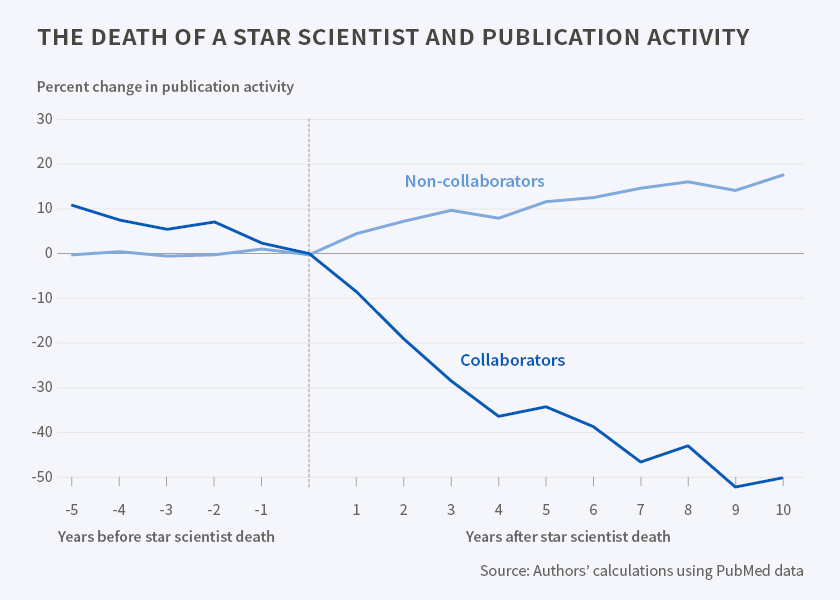
The authors tracked the publication records of scientists — both collaborators and non-collaborators — before and after a "research superstar" died. To narrow the scope of their study, they focused on academics in the life sciences, a sector which is heavily supported by National Institutes of Health funding and produces a high volume of research. They established a list of 12,935 elite scientists using criteria such as the amount of research funding received, publication citations, number of patents, membership in prestigious organizations, and career awards and prizes. They then examined records of 452 of those elite scientists who died prematurely — before retiring or becoming administrators — between 1975 and 2003. Publication data was gathered from the National Library of Medicine's PubMed service, which indexes and tracks articles by research topics, names of authors and coauthors, citations, related articles, and other information from 40,000 publications.
The findings confirm previous work showing that the number of articles by collaborators decreased substantially — by about 40 percent — after the death of a star scientist. Publication activity by non-collaborators increased by an average of 8 percent after the death of an elite scientist. By five years after the death, this activity of non-collaborators fully offset the productivity decline of collaborators. "These additional contributions are disproportionately likely to be highly cited," the researchers found. "They are also more likely to be authored by scientists who were not previously active in the deceased superstar's field."
Few of the deceased scientists served as editors of academic journals or on committees overseeing the issuance of research grants, so the researchers rule out the possibility that the deceased scientists used their influence to limit who could or could not publish their work or receive grants within their field. Instead, they say, the evidence suggests that outsiders were reluctant to challenge the leadership within research areas in which an elite scientist was active. While entry occurs after a star's passing, it is not monolithic. Key collaborators left behind can regulate entry into the field through the control of intellectual, social, and resource barriers.
"While coauthors suffer after the passing of a superstar, it is not simply the case that star scientists in a competing lab assume the leadership mantle," the authors conclude. "Rather, the boost comes largely from outsiders who appear to tackle the mainstream questions within the field but by leveraging newer ideas that arise in other domains. This intellectual arbitrage is quite successful — the new articles represent substantial contributions, at least as measured by long-run citation impact."
—Jay Fitzgerald
Sunday, November 2, 2014
A Tribute to Lawrence R. Klein

I owe an immense debt of
gratitude to Larry Klein, who helped guide, support and inspire my career for more than three
decades. Let me offer just a few vignettes.
Circa 1979 I was an undergraduate studying finance and economics at Penn's Wharton School, where I had my first economics job. I was as a research assistant at Larry's firm, Wharton Econometric Forecasting Associates (WEFA). I didn't know Larry at the time; I got the job via a professor whose course I had taken, who was a friend of a friend of Larry's. I worked for a year or so, perhaps ten or fifteen hours per week, on regional electricity demand modeling and forecasting. Down the hall were the U.S. quarterly and annual modeling groups, where I eventually moved and spent another year. Lots of fascinating people roamed the maze of cubicles, from eccentric genius-at-large Mike McCarthy, to Larry and Sonia Klein themselves, widely revered within WEFA as god and goddess. During fall of 1980 I took Larry's Wharton graduate macro-econometrics course and got to know him. He won the Nobel Prize that semester, on a class day, resulting in a classroom filled with television cameras. What a heady mix!
I stayed at Penn for graduate studies, moving in 1981 from Wharton to Arts and Sciences, home of the Department of Economics and Larry Klein. I have no doubt that my decision to stay at Penn, and to move to the Economics Department, was heavily dependent on Larry's presence there. During the summer following my first year of the Ph.D. program, I worked on a variety of country models for Project LINK, under the supervision Larry and another leading modeler in the Klein tradition, Peter Pauly. It turned out that the LINK summer job pushed me over the annual salary cap for a graduate student -- $6000 or so 1982 dollars, if I remember correctly -- so Larry and Peter paid me the balance in kind, taking me to the Project LINK annual meeting in Wiesbaden, Germany. More excitement, and also my first trip abroad.
Both Larry and Peter helped supervise my 1986 Penn Ph.D. dissertation, on ARCH modeling of asset return volatility. I couldn't imagine a better trio of advisors: Marc Nerlove as main advisor, with committee members Larry and Peter (who introduced me to ARCH). I took a job at the Federal Reserve Board, with the Special Studies Section led by Peter Tinsley, a pioneer in optimal control of macro-econometric models. Circa 1986 Larry had more Ph.D. students at the Board than anyone else, by a wide margin. Surely that helped me land the Special Studies job. Another Klein student, Glenn Rudebusch, also went from Penn to the Board that year, and we wound up co-authoring a dozen articles and two books over nearly thirty years. My work and lasting friendship with Glenn trace in significant part to our melding in the Klein crucible.
I returned to Penn in 1989 as an assistant professor. Although I have no behind-the-scenes knowledge, it's hard to imagine that Larry's input didn't contribute to my invitation to return. Those early years were memorable for many things, including econometric socializing. During the 1990's my wife Susan and I had lots of parties at our home for faculty and students. The Kleins were often part of the group, as were Bob and Anita Summers, Herb and Helene Levine, Bobby and Julie Mariano, Jere Behrman and Barbara Ventresco, Jerry Adams, and many more. I recall a big party on one of Penn's annual Economics Days, which that year celebrated The Keynesian Revolution, Larry's landmark 1947 monograph.
The story continues, but I'll mention just one more thing. I was honored and humbled to deliver the Lawrence R. Klein Lecture at the 2005 Project LINK annual meeting in Mexico City, some 25 years after Larry invited a green 22-year-old to observe the 1982 meeting in Wiesbaden.
I have stressed guidance and support, but in closing let me not forget inspiration, which Larry also provided for three decades, in spades. He was the ultimate scholar, focused and steady, and the ultimate gentleman, remarkably gracious under pressure.
A key point, of course, is that it's not about what Larry provided me, whether guidance, support or inspiration -- I'm just one member of this large group. Larry generously provided for all of us, and for thousands of others who couldn't be here tonight, enriching all our lives. Thanks Larry. We look forward to working daily to honor and advance your legacy.
Monday, October 13, 2014
Lawrence R. Klein Legacy Colloquium

In Memoriam
The Department of Economics of the University of
Pennsylvania, with kind support from the School of Arts and Sciences, the
Wharton School, PIER and IER, is pleased is pleased to host a colloquium, "The Legacy of Lawrence R. Klein: Macroeconomic Measurement, Theory, Prediction and Policy," on Penn’s campus, Saturday, October 25, 2014. The full program and related information are here. We look forward to
honoring Larry’s legacy throughout the day. Please join us if you can.
Featuring:
- Olav Bjerkholt, Professor of Economics, University of Oslo
- Harold L. Cole, Professor of Economics and Editor of International Economic Review, University of Pennsylvania
- Thomas F. Cooley, Paganelli-Bull Professor of Economics, New York University
- Francis X. Diebold, Paul F. Miller, Jr. and E. Warren Shafer Miller Professor of Economics, University of Pennsylvania
- Jesus Fernandez-Villaverde, Professor of Economics, University of Pennsylvania
- Dirk Krueger, Professor and Chair of the Department of Economics, University of Pennsylvania
- Enrique G. Mendoza, Presidential Professor of Economics and Director of Penn Institute for Economic Research, University of Pennsylvania
- Glenn D. Rudebusch, Executive Vice President and Director of Research, Federal Reserve Bank of San Francisco
- Frank Schorfheide, Professor of Economics, University of Pennsylvania
- Christopher A. Sims, John F. Sherrerd ‘52 University Professor of Economics, Princeton University
- Ignazio Visco, Governor of the Bank of Italy
Sunday, May 4, 2014
Gary Becker, 1930-2014
Very sad to report that Gary Becker has passed away. See news.uchicago.edu/article/2014/05/04/gary-s-becker-nobel-winning-scholar-economics-and-sociology-1930-2014?utm_source=newsmodule .

Monday, March 24, 2014
Sheldon Hackney Memorial Celebration, March 27
Monday, October 21, 2013
Lawrence R. Klein, 1920-2013
I am sad to report that Lawrence R. Klein has passed away. He was in many respects the father of modern econometrics and empirical macroeconomics; indeed his 1980 Nobel Prize citation was "for the creation of econometric models and their application to the analysis of economic fluctuations and economic policies." He was also a dear friend and mentor to legions of Penn faculty and students, including me. I am grateful to him for many things, including his serving on my Penn Ph.D. dissertation committee nearly thirty years ago.
You can find a beautiful and fascinating autobiographical essay written in 1980, and updated in 2005, here.
Check back during the coming days as I update this post with additional links and materials.
Update 1: KLEIN LAWRENCE, October 20, 2013, of Gladwyne, Pa. Husband of Sonia (nee Adelson). Father of Hannah Klein, Rebecca (James) Kennedy, Rachel (Lyle) Klein and Jonathan (Blandina) Klein. Also survived by 7 grandchildren and 4 great-grandchildren. Services and Interment are private. Relatives and friends are invited to the residence of Mrs. Sonia Klein Wednesday, October 23, 2-4 P.M. AND Saturday, October 26, 2-4 P.M. (only). Contributions in his memory may be made to the University of Pennsylvania Department of Economics.
Update 2: Extensive New York Times obituary here.
Update 3: Penn Economics memorial statement here.
Update 4: Saturday 26 October Financial Times Weekend will contain an extensive obituary.
Wednesday, September 25, 2013
Sheldon Hackney: A Truly Great Penn Man
Sheldon Hackney, Penn's president 1981-1993, recently passed away. See the fine coverage in the Almanac and Daily Pennsylvanian.
In my younger days as a Penn undergrad, Hackney took a lot of abuse. People felt that he didn't have much backbone. Exhibit 1 was always his failure to stand up to the water buffalo thing, letting political correctness run amok. I too felt that way.
But now, with the benefit of more information providing breadth and depth of hindsight, I see that I was wrong. Yes, he botched the water buffalo thing. But now I see that as just a small detour in a heroic career.
Thanks, Sheldon, for seeing things clearly in Alabama, for taking your case to Penn, the nation, and the world, for testifying to the truth, day in and day out. Thanks for relishing the joy of being a professor first and always. Thanks for engaging Penn's neighbors, and for laying the groundwork for Penn's eastward expansion. And thanks for your famous civility, your stunning grace under pressure, a model for us all. I recall the Fleetwood Mac lyric, from just slightly before your Penn arrival, "Can I sail through the changing ocean tides, can I handle the seasons of my life?" May I do half as well as you.
In my younger days as a Penn undergrad, Hackney took a lot of abuse. People felt that he didn't have much backbone. Exhibit 1 was always his failure to stand up to the water buffalo thing, letting political correctness run amok. I too felt that way.
But now, with the benefit of more information providing breadth and depth of hindsight, I see that I was wrong. Yes, he botched the water buffalo thing. But now I see that as just a small detour in a heroic career.
Thanks, Sheldon, for seeing things clearly in Alabama, for taking your case to Penn, the nation, and the world, for testifying to the truth, day in and day out. Thanks for relishing the joy of being a professor first and always. Thanks for engaging Penn's neighbors, and for laying the groundwork for Penn's eastward expansion. And thanks for your famous civility, your stunning grace under pressure, a model for us all. I recall the Fleetwood Mac lyric, from just slightly before your Penn arrival, "Can I sail through the changing ocean tides, can I handle the seasons of my life?" May I do half as well as you.
Subscribe to:
Posts (Atom)