As the expansion ages, there's progressively more discussion of whether its advanced age makes it more likely to end. The answer is no. More formally, postwar U.S. expansion hazards are basically flat, in contrast to contraction hazards, which are sharply increasing. Of course the present expansion will eventually end, and it may even end soon, but its age it unrelated to its probability of ending.
All of this is very clear in Diebold, Rudebusch and Sichel (1992). See Figure 6.2 on p. 271. (Sorry for the poor photocopy quality.) The flat expansion hazard result has held up well (e.g., Rudebusch (2016)), and moreover it would only be strengthened by the current long expansion.
[I blogged on flat expansion hazards before, but the message bears repeating as the expansion continues to age.]

Showing posts with label Macro-econometrics. Show all posts
Showing posts with label Macro-econometrics. Show all posts
Sunday, October 28, 2018

Monday, March 19, 2018
Big Data and Economic Nowcasting
Check out this informative paper from the Federal Reserve Bank of New York: "Macroeconomic Nowcasting and Forecasting with Big Data", by Brandyn Bok, Daniele Caratelli, Domenico Giannone, Argia Sbordone, and Andrea Tambalotti.
Key methods for confronting big data include (1) imposition of restrictions (for example, (a) zero restrictions correspond to "sparsity", (b) reduced-rank restrictions correspond to factor structure, etc.), and (2) shrinkage (whether by formal Bayesian approaches or otherwise).
Bok et al. provide historical perspective on use of (1)(b) for macroeconomic nowcasting; that is, for real-time analysis and interpretation of hundreds of business-cycle indicators using dynamic factor models. They also provide a useful description of FRBNY's implementation and use of such models in policy deliberations.
It is important to note that the Bok et al. approach nowcasts current-quarter GDP, which is different from nowcasting "the business cycle" (as done using dynamic factor models at FRB Philadelphia, for example), because GDP alone is not the business cycle. Hence the two approaches are complements, not substitutes, and both are useful.
Key methods for confronting big data include (1) imposition of restrictions (for example, (a) zero restrictions correspond to "sparsity", (b) reduced-rank restrictions correspond to factor structure, etc.), and (2) shrinkage (whether by formal Bayesian approaches or otherwise).
Bok et al. provide historical perspective on use of (1)(b) for macroeconomic nowcasting; that is, for real-time analysis and interpretation of hundreds of business-cycle indicators using dynamic factor models. They also provide a useful description of FRBNY's implementation and use of such models in policy deliberations.
It is important to note that the Bok et al. approach nowcasts current-quarter GDP, which is different from nowcasting "the business cycle" (as done using dynamic factor models at FRB Philadelphia, for example), because GDP alone is not the business cycle. Hence the two approaches are complements, not substitutes, and both are useful.
Monday, December 5, 2016
Exogenous vs. Endogenous Volatility Dynamics
I always thought putting exogenous volatility dynamics in macro-model shocks was a cop-out. Somehow it seemed more satisfying for volatility to be determined endogenously, in equilibrium. Then I came around: We allow for shocks with exogenous conditional-mean dynamics (e.g., AR(1)), so why shouldn't we allow for shocks with exogenous conditional-volatility dynamics? Now I might shift back, at least in part, thanks to new work by Sydney Ludvigson, Sai Ma, and Serena Ng, "Uncertainty and Business Cycles: Exogenous Impulse or
Endogenous Response?", which attempts to sort things out. The October 2016 version is here. It turns out that real (macro) volatility appears largely endogenous, whereas nominal (financial market) volatility appears largely exogenous.
Monday, October 31, 2016
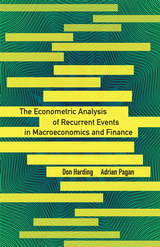
Econometric Analysis of Recurrent Events
Monday, November 23, 2015
On Bayesian DSGE Modeling with Hard and Soft Restrictions
A theory is essentially a restriction on a reduced form. It can be imposed directly (hard restrictions) or used as as a prior mean in a more flexible Bayesian analysis (soft restrictions). The soft restriction approach -- "theory as a shrinkage direction" -- is appealing: coax parameter configurations toward a prior mean suggested by theory, but also respect the likelihood, and govern the mix by prior precision.
(1) Important macro-econometric DSGE work, dating at least to the classic Ingram and Whiteman (1994) paper, finds that using theory as a VAR shrinkage direction is helpful for forecasting.
(2) But that's not what most Bayesian DSGE work now does. Instead it imposes hard theory restrictions on a VAR, conditioning completely on an assumed DSGE model, using Bayesian methods simply to coax the assumed model's parameters toward "reasonable" values.
It's not at all clear that approach (2) should dominate approach (1) for prediction, and indeed research like Del Negro and Schorfheide (2004) and Del Negro and Schorfheide (2007) indicates that it doesn't.
I like (1) and I think it needs renewed attention.
[A related issue is whether "theory priors" will supplant others, like the "Minnesota prior." I'll save that for a later post.]
(1) Important macro-econometric DSGE work, dating at least to the classic Ingram and Whiteman (1994) paper, finds that using theory as a VAR shrinkage direction is helpful for forecasting.
(2) But that's not what most Bayesian DSGE work now does. Instead it imposes hard theory restrictions on a VAR, conditioning completely on an assumed DSGE model, using Bayesian methods simply to coax the assumed model's parameters toward "reasonable" values.
It's not at all clear that approach (2) should dominate approach (1) for prediction, and indeed research like Del Negro and Schorfheide (2004) and Del Negro and Schorfheide (2007) indicates that it doesn't.
I like (1) and I think it needs renewed attention.
[A related issue is whether "theory priors" will supplant others, like the "Minnesota prior." I'll save that for a later post.]
Thursday, September 24, 2015
Coolest Paper at 2015 Jackson Hole
The Faust-Leeper paper is wild and wonderful. The friend who emailed it said, "Be prepared, it’s very different but a great picture of real-time forecasting..." He got it right.
Actually his full email was, "Be prepared, it’s very different but a great picture of real-time forecasting, and they quote Zarnowitz." (He and I always liked and admired Victor Zarnowitz. But that's another post.)
The paper shines its light all over the place, and different people will read it differently. I did some spot checks with colleagues. My interpretation below resonated with some, while others wondered if we had read the same paper. Perhaps, as with Keynes, we'll never know exactly what Faust-Leeper really, really, really meant.
I read Faust-Leeper as speaking to factor analysis in macroeconomics and finance, arguing that dimensionality reduction via factor structure, at least as typically implemented and interpreted, is of limited value to policymakers, although the paper never uses wording like "dimensionality reduction" or "factor structure".
If Faust-Leeper are doubting factor structure itself, then I think they're way off base. It's no accident that factor structure is at the center of both modern empirical/theoretical macro and modern empirical/theoretical finance. It's really there and it really works.
Alternatively, if they're implicitly saying something like this, then I'm interested:
Small-scale factor models involving just a few variables and a single common factor (or even two factors like "real activity" and "inflation") are likely missing important things, and are therefore incomplete guides for policy analysis.
Or, closely related and more constructively:
We should cast a wide net in terms of the universe of observables from which we extract common factors, and the number of factors that we extract. Moreover we should examine and interpret not only common factors, but also allegedly "idiosyncratic" factors, which may actually be contemporaneously correlated, time dependent, or even trending, due to mis-specification.
Enough. Read it for yourself.
[General note: My use of terms like "factor modeling" throughout this post should be broadly interpreted to include not only explicit reduced-form statistical/econometric dynamic factor modeling, but also structural DSGE modeling.]
Actually his full email was, "Be prepared, it’s very different but a great picture of real-time forecasting, and they quote Zarnowitz." (He and I always liked and admired Victor Zarnowitz. But that's another post.)
The paper shines its light all over the place, and different people will read it differently. I did some spot checks with colleagues. My interpretation below resonated with some, while others wondered if we had read the same paper. Perhaps, as with Keynes, we'll never know exactly what Faust-Leeper really, really, really meant.
I read Faust-Leeper as speaking to factor analysis in macroeconomics and finance, arguing that dimensionality reduction via factor structure, at least as typically implemented and interpreted, is of limited value to policymakers, although the paper never uses wording like "dimensionality reduction" or "factor structure".
If Faust-Leeper are doubting factor structure itself, then I think they're way off base. It's no accident that factor structure is at the center of both modern empirical/theoretical macro and modern empirical/theoretical finance. It's really there and it really works.
Alternatively, if they're implicitly saying something like this, then I'm interested:
Small-scale factor models involving just a few variables and a single common factor (or even two factors like "real activity" and "inflation") are likely missing important things, and are therefore incomplete guides for policy analysis.
Or, closely related and more constructively:
We should cast a wide net in terms of the universe of observables from which we extract common factors, and the number of factors that we extract. Moreover we should examine and interpret not only common factors, but also allegedly "idiosyncratic" factors, which may actually be contemporaneously correlated, time dependent, or even trending, due to mis-specification.
Enough. Read it for yourself.
[General note: My use of terms like "factor modeling" throughout this post should be broadly interpreted to include not only explicit reduced-form statistical/econometric dynamic factor modeling, but also structural DSGE modeling.]
Monday, September 7, 2015
BEA to Resume Provision of NSA GDP
In an earlier post, I argued for publication of non-seasonally-adjusted (NSA) series. Thanks to a helpful communication from Jonathan Wright, I recently learned (as did he) that BEA will resume compilation and publication of NSA U.S. GDP.
The official announcement is simply, "BEA will develop a NSA GDP that will be released in parallel with BEA’s quarterly GDP estimates." It's buried at the end of the box on p. 5 of "Preview of the 2015 Annual Revision of the National Income and Product Accounts," by Stephanie H. McCulla and Shelly Smith in the June 2015 Survey of Current Business. Rumor has it that we should look for the new NSA series to appear starting in late 2016 or early 2017.
Obviously my No Hesitations post was too late to have influenced the
BEA’s decision, but other academic work may have played a role, notably Jonathan Wright's 2013 Brookings Papers piece (which stresses "overadjustment" in seasonally-adjusted data) and Chuck Manski's forthcoming 2015 Journal of Economic Literature piece (which stresses conceptual difficulties with seasonally-adjusted data).
Thanks BEA, for resuscitating NSA GDP. It’s the right thing to do.
Thanks BEA, for resuscitating NSA GDP. It’s the right thing to do.
Monday, July 27, 2015
Rebonato on Bond-Yield Econometrics
Riccardo Rebonato (R) has a fascinating new paper, which builds on important earlier work of Cieslak and Povala (2010) (CP).
The cool thing about CP is the way it advances and blends certain aspects of both the spanning literature ("all information of relevance for yield prediction is embedded in the current term structure," e.g. via forward-rate tent functions as in Cochrane-Piazessi (2004)), and the non-spanning literature ("not all information of relevance for yield prediction is embedded in the current term structure," e.g. because certain macro variables seem to help predict risk premia, as in Ludvidson and Ng (2009)).
In turn, the cool thing about R is its insightful high-frequency / low-frequency interpretation of CP, with the macro predictors of primary relevance at low frequencies.
Adapted from the R abstract:
This paper presents a simple reformulation of the restricted CP return-predicting factor which retains by construction exactly the same (impressive) explanatory power as the original one, but affords an alternative and attractive interpretation. What determines future returns, the new factor shows, is ... the distance of the yield-curve level and the slope not from fixed reference levels, but from conditional ones determined by ... long-term inflation.
I'm reminded of key early work by Kozicki and Tinsley (2001) on market perceptions of central bank credibility providing low-frequency anchoring for long yields.
More generally, high-frequency / low-frequency decompositions have a long and distinguished history in time-series econometrics, from cycle / trend real-output decompositions in macro-econometrics (e.g., Cochrane (1988)) to short-run / long-run volatility decompositions in financial econometrics (e.g., the "component GARCH" model of Engle and Lee (1999)).
More generally, high-frequency / low-frequency decompositions have a long and distinguished history in time-series econometrics, from cycle / trend real-output decompositions in macro-econometrics (e.g., Cochrane (1988)) to short-run / long-run volatility decompositions in financial econometrics (e.g., the "component GARCH" model of Engle and Lee (1999)).
A final thought: Bauer and Hamilton (2015) have recently questioned the entire non-spanning literature. Perhaps I'll cover that in a subsequent post, and its relation to CP and R (e.g., why worry about blending the spanning and non-spanning approaches if the non-spanning approach is suspect?).
Thursday, June 25, 2015
Measuring and Monitoring Connectedness
I'm at the IMF soon for a couple days of lecturing on Diebold-Yilmaz's Connectedness. It was published earlier this year, and preparing for the IMF jogged my memory: I brilliantly forgot to announce it in a No Hesitations post. Anyway, it's available at the usual online shops (where you can also read the T.O.C. and first chapter), or directly from Oxford University Press. There's also a web site. Special thanks to Eric Ghysels, who put us in touch with our fine editor, Scott Parris.

Tuesday, May 26, 2015
New GDP Series From BEA
BEA's "new product" (see below) -- a U.S. GDP estimate that's a simple average of expenditure- and income-side GDP estimates -- is not yet at the cutting-edge of historical GDP estimation.
On the benefits of blending the expenditure- and income-side historical GDP estimates, see ADNSS1 for a forecast-combination perspective and ADNSS2 for a Kalman-filtering signal-extraction perspective. The ADNSS1 "combined" GDP estimate is a convex combination of expenditure- and income-side GDP estimates, but the BEA equal-weight case is very special and generally sub-optimal. Moreover, ADNSS2's Kalman-filter approach is likely superior to ADNSS1's convex-combination approach for reasons detailed by ADNSS2, and for some years now it has been implemented and published to the web by FRB Philadelphia as "GDPplus".
Neverthess, I applaud the BEA's new averaged GDP. If it's not at the cutting edge, it's nevertheless much superior to the standard approach of doing nothing -- that is, using expenditure-side GDP alone -- and it's an official acknowledgment of the wastefulness of doing so. Hence it's a significant step in the right direction. Hopefully its publication by BEA will nudge people away from uncritical and exclusive reliance on expenditure-side GDP.

May 14, 2015
Twitter: @BEA_News
www.bea.gov
Coming in July:
BEA to Launch New Tools for Analyzing Economic Growth
WASHINGTON – The Bureau of Economic Analysis plans to launch two new statistics that will serve as tools to help businesses, economists, policymakers and the American public better analyze the performance of the U.S. economy. These tools will be available on July 30 and emerge from an annual BEA process where improvements and revisions to GDP data are implemented. BEA created these two new tools in response to demand from our customers.
Average of Gross Domestic Product (GDP) and Gross Domestic Income (GDI)
-- BEA will launch a new series that is an average of GDP and GDI, giving users another way to track U.S. economic growth.
-- BEA will present a nominal (or current-dollar) measure of the series and an inflation-adjusted (or chained-dollar) measure of the series.
-- For current dollars, the new measure will be a simple, equally weighted average of GDP and GDI for any given quarter or year.
-- For chained dollars, the new measure will be the current-dollar value deflated by the GDP price index.
-- The new series will be available back to 1929 on an annual basis and to 1947 on a quarterly basis.
-- The new series will not only provide users with another barometer on the U.S. economy but also make available series that several independent experts have recommended using in their analysis of the nation’s economic growth.
-- The new series could help account for known measurement inconsistencies between the two statistics. Those may include timing differences, gaps in underlying source data, and survey measurement errors.
-- The new statistics will be available in BEA’s interactive database as well as in the GDP news release tables.
On the benefits of blending the expenditure- and income-side historical GDP estimates, see ADNSS1 for a forecast-combination perspective and ADNSS2 for a Kalman-filtering signal-extraction perspective. The ADNSS1 "combined" GDP estimate is a convex combination of expenditure- and income-side GDP estimates, but the BEA equal-weight case is very special and generally sub-optimal. Moreover, ADNSS2's Kalman-filter approach is likely superior to ADNSS1's convex-combination approach for reasons detailed by ADNSS2, and for some years now it has been implemented and published to the web by FRB Philadelphia as "GDPplus".
May 14, 2015
Twitter: @BEA_News
www.bea.gov
Coming in July:
BEA to Launch New Tools for Analyzing Economic Growth
WASHINGTON – The Bureau of Economic Analysis plans to launch two new statistics that will serve as tools to help businesses, economists, policymakers and the American public better analyze the performance of the U.S. economy. These tools will be available on July 30 and emerge from an annual BEA process where improvements and revisions to GDP data are implemented. BEA created these two new tools in response to demand from our customers.
Average of Gross Domestic Product (GDP) and Gross Domestic Income (GDI)
-- BEA will launch a new series that is an average of GDP and GDI, giving users another way to track U.S. economic growth.
-- BEA will present a nominal (or current-dollar) measure of the series and an inflation-adjusted (or chained-dollar) measure of the series.
-- For current dollars, the new measure will be a simple, equally weighted average of GDP and GDI for any given quarter or year.
-- For chained dollars, the new measure will be the current-dollar value deflated by the GDP price index.
-- The new series will be available back to 1929 on an annual basis and to 1947 on a quarterly basis.
-- The new series will not only provide users with another barometer on the U.S. economy but also make available series that several independent experts have recommended using in their analysis of the nation’s economic growth.
-- The new series could help account for known measurement inconsistencies between the two statistics. Those may include timing differences, gaps in underlying source data, and survey measurement errors.
-- The new statistics will be available in BEA’s interactive database as well as in the GDP news release tables.
Thursday, May 14, 2015
Interesting New Work on Yield Curve Modeling
Loved last week's PIER lectures at Penn. Good people, good times, good spring weather. (Please join us next year in May 2016! More information in due course.) On Thursday we did yield curves, which had me thinking about what's new that I like in that area. Not surprisingly, I'm a fan of dynamic Nelson-Siegel (DNS), arbitrage-Free Nelson-Siegel (AFNS), and the many variations. (See the Diebold-Rudebusch 2013 book.) What's more surprising is that although Nelson-Siegel is almost thirty years old, and DNS/AFNS is almost a teenager, interesting and useful new variations keep coming along.
The most important new work concerns imposition of the zero lower bound (ZLB). Fischer Black's "shadow rate" approach has influenced me most. Recently it's been taken to new heights by Glenn Rudebusch and coauthors at the Federal Reserve Bank of San Francisco (e.g., Christensen and Rudebusch 2015 -- just published in Journal of Financial Econometrics), and Leo Krippner at the Reserve Bank of New Zealand (see his wonderful 2015 book). The amazing thing is that one can stay in the DNS/AFNS framework -- the key tractable subclass of Gaussian affine models -- and still respect the ZLB by appropriately truncating simple simulations. The figure below, assembled from some of Krippner's, says it all. Also see these slides.


I'm also partial to shadow-rate ZLB work by Cynthia Wu and coauthors at Chicago and San Diego (e.g. Wu and Xia, 2014). (Thanks to Jim Hamilton, her Ph.D. advisor, for reminding me!) See the monthly Wu-Xia shadow short rate series, produced and published to the web by FRB Atlanta.
Last and not at all least is the recent "ARG0" work of Monfort et al., which imposes the ZLB in a very different and elegant way. Again see these slides.
Another interesting strand of recent DNS/AFNS progress concerns modeling the interaction of bond yield factors, macro fundamentals, and central bank policy. More on that sometime soon.
The most important new work concerns imposition of the zero lower bound (ZLB). Fischer Black's "shadow rate" approach has influenced me most. Recently it's been taken to new heights by Glenn Rudebusch and coauthors at the Federal Reserve Bank of San Francisco (e.g., Christensen and Rudebusch 2015 -- just published in Journal of Financial Econometrics), and Leo Krippner at the Reserve Bank of New Zealand (see his wonderful 2015 book). The amazing thing is that one can stay in the DNS/AFNS framework -- the key tractable subclass of Gaussian affine models -- and still respect the ZLB by appropriately truncating simple simulations. The figure below, assembled from some of Krippner's, says it all. Also see these slides.


I'm also partial to shadow-rate ZLB work by Cynthia Wu and coauthors at Chicago and San Diego (e.g. Wu and Xia, 2014). (Thanks to Jim Hamilton, her Ph.D. advisor, for reminding me!) See the monthly Wu-Xia shadow short rate series, produced and published to the web by FRB Atlanta.
Last and not at all least is the recent "ARG0" work of Monfort et al., which imposes the ZLB in a very different and elegant way. Again see these slides.
Another interesting strand of recent DNS/AFNS progress concerns modeling the interaction of bond yield factors, macro fundamentals, and central bank policy. More on that sometime soon.
Friday, May 8, 2015
Vienna Workshop on High-Dimensional Time Series In Macroeconomics and Finance
Program looking good: https://www.conftool.net/timeseries2015/sessions.php. Presumably papers will be posted, or at least you can email the authors.
Sunday, January 11, 2015
Mostly Harmless Econometrics?
I've had Angrist-Pischke's Mostly Harmless Econometrics: An Empiricist's Companion (MHE) for a while, but I just got around to reading it. (By the way, a lower-level follow-up was just published.)
There's a lot to like about MHE. It's an insightful and fun treatment of micro-econometric regression-based causal effect estimation -- basically how to (try to) tease causal information from least-squares regressions fit to observational micro data. It's filled with wisdom, exploring many subtleties and nuances. In many ways it's written not for students at age 23, but rather for seasoned researchers at age 53. And it tells its story in a marvelously engaging conversational style.
But there's also a lot not to like about MHE. The problem isn't what it includes, but rather what it excludes. Starting with its title and continuing throughout, MHE promotes its corner of applied econometrics as all of applied econometrics, or at least all of the "mostly harmless" part (whatever that means). Hence it effectively condemns much of the rest as "harmful," and sentences it to death by neglect. It gives the silent treatment, for example, to anything structural -- whether micro-econometric or macro-econometric -- and anything involving time series. And in the rare instances when silence is briefly broken, we're treated to gems like "serial correlation [until recently was] Somebody Else's Problem, specifically the unfortunate souls who make their living out of time series data (macroeconomists, for example)" (pp. 315-316).
[Here's a rough parallel. Consider Hansen and Sargent's Recursive Models of Dynamic Linear Economies. It treats structural analysis and econometric estimation of dynamic macroeconomic models, and it naturally contains large doses of time series, state space, optimal filtering, etc. It's also appropriately titled and appropriately pitched. Now imagine that Hansen and Sargent had instead titled it Mostly Harmless Econometrics, declared its contents to be the central part of (the mostly harmless part of) applied econometrics, and pitched it as a general "empiricist's companion". Voilà!]
All told, Mostly Harmless Econometrics: An Empiricist's Companion is neither "mostly harmless" nor an "empiricist's companion." Rather, it's a companion for a highly-specialized group of applied non-structural micro-econometricians hoping to estimate causal effects using non-experimental data and largely-static, linear, regression-based methods. It's a novel treatment of that sub-sub-sub-area of applied econometrics, but pretending to be anything more is most definitely harmful, particularly to students, who have no way to recognize the charade as a charade.
There's a lot to like about MHE. It's an insightful and fun treatment of micro-econometric regression-based causal effect estimation -- basically how to (try to) tease causal information from least-squares regressions fit to observational micro data. It's filled with wisdom, exploring many subtleties and nuances. In many ways it's written not for students at age 23, but rather for seasoned researchers at age 53. And it tells its story in a marvelously engaging conversational style.
But there's also a lot not to like about MHE. The problem isn't what it includes, but rather what it excludes. Starting with its title and continuing throughout, MHE promotes its corner of applied econometrics as all of applied econometrics, or at least all of the "mostly harmless" part (whatever that means). Hence it effectively condemns much of the rest as "harmful," and sentences it to death by neglect. It gives the silent treatment, for example, to anything structural -- whether micro-econometric or macro-econometric -- and anything involving time series. And in the rare instances when silence is briefly broken, we're treated to gems like "serial correlation [until recently was] Somebody Else's Problem, specifically the unfortunate souls who make their living out of time series data (macroeconomists, for example)" (pp. 315-316).
[Here's a rough parallel. Consider Hansen and Sargent's Recursive Models of Dynamic Linear Economies. It treats structural analysis and econometric estimation of dynamic macroeconomic models, and it naturally contains large doses of time series, state space, optimal filtering, etc. It's also appropriately titled and appropriately pitched. Now imagine that Hansen and Sargent had instead titled it Mostly Harmless Econometrics, declared its contents to be the central part of (the mostly harmless part of) applied econometrics, and pitched it as a general "empiricist's companion". Voilà!]
All told, Mostly Harmless Econometrics: An Empiricist's Companion is neither "mostly harmless" nor an "empiricist's companion." Rather, it's a companion for a highly-specialized group of applied non-structural micro-econometricians hoping to estimate causal effects using non-experimental data and largely-static, linear, regression-based methods. It's a novel treatment of that sub-sub-sub-area of applied econometrics, but pretending to be anything more is most definitely harmful, particularly to students, who have no way to recognize the charade as a charade.
Subscribe to:
Posts (Atom)