Sophocles Mavroeidis at Oxford has a very nice paper on using the nominal interest rate zero lower bound (ZLB) to identify VAR's. Effectively, hitting the ZLB is a form of (endogenous) structural change that can be exploited for identification. He has results showing whether/when one has point identification, set identification, or no identification. Really good stuff.
An interesting question is whether there may be SETS of bounds that may be hit. Suppose so, and suppose that we don't know whether/when they'll be hit, but we do know that if/when one bound is hit, all bounds are hit. An example might be nominal short rates in two countries with tightly-integrated money markets.
Now recall the literature on testing for multivariate structural change, which reveals large power increases in such situations (Bai, Lumsdaine and Stock). In Sophocles' case, it suggests the potential for greatly sharpened set ID. Of course it all depends on the truth/relevance of my supposition...

Showing posts with label Yield Curves. Show all posts
Showing posts with label Yield Curves. Show all posts
Monday, April 8, 2019

Monday, January 8, 2018
Yield-Curve Modeling
Happy New Year to all!
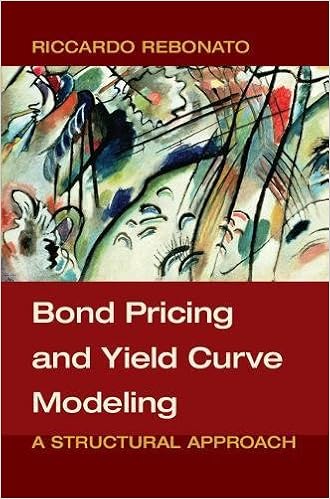
Riccardo Rebonato's Bond Pricing and Yield-Curve Modeling: A Structural Approach will soon appear from Cambridge University Press. It's very well done -- a fine blend of theory, empirics, market sense, and good prose. And not least, endearing humility, well-captured by a memorable sentence from the acknowledgements: "My eight-year-old son has forgiven me, I hope, for not playing with him as much as I would have otherwise; perhaps he has been so understanding because he has had a chance to build a few thousand paper planes with the earlier drafts of this book."
TOC below. Pre-order here.
Contents
Acknowledgements page ix
Symbols and Abbreviations xi
Part I The Foundations
1 What This Book Is About 3
2 Definitions, Notation and a Few Mathematical Results 24
3 Links among Models, Monetary Policy and the Macroeconomy 49
4 Bonds: Their Risks and Their Compensations 63
5 The Risk Factors in Action 81
6 Principal Components: Theory 98
7 Principal Components: Empirical Results 108
Part II The Building Blocks: A First Look
8 Expectations 137
9 Convexity: A First Look 147
10 A Preview: A First Look at the Vasicek Model 160
Part III The Conditions of No-Arbitrage
11 No-Arbitrage in Discrete Time 185
12 No-Arbitrage in Continuous Time 196
13 No-Arbitrage with State Price Deflators 206
14 No-Arbitrage Conditions for Real Bonds 224
15 The Links with an Economics-Based Description of Rates 241
Part IV Solving the Models
16 Solving Affine Models: The Vasicek Case 263
17 First Extensions 285
18 A General Pricing Framework 299
19 The Shadow Rate: Dealing with a Near-Zero Lower Bound 329
Part V The Value of Convexity
20 The Value of Convexity 351
21 A Model-Independent Approach to Valuing Convexity 371
22 Convexity: Empirical Results 391
Part VI Excess Returns
23 Excess Returns: Setting the Scene 415
24 Risk Premia, the Market Price of Risk and Expected Excess Returns 431
25 Excess Returns: Empirical Results 449
26 Excess Returns: The Recent Literature – I 473
27 Excess Returns: The Recent Literature – II 497
28 Why Is the Slope a Good Predictor? 527
29 The Spanning Problem Revisited 547
Part VII What the Models Tell Us
30 The Doubly Mean-Reverting Vasicek Model 559
31 Real Yields, Nominal Yields and Inflation: The D’Amico–Kim–Wei Model 575
32 From Snapshots to Structural Models: The Diebold–Rudebusch Approach 602
33 Principal Components as State Variables of Affine Models: The PCA Affine Approach 618
34 Generalizations: The Adrian–Crump–Moench Model 663
35 An Affine, Stochastic-Market-Price-of-Risk Model 688
36 Conclusions 714
Bibliography 725
index 000
Sunday, November 5, 2017
Regression on Term Structures
An important insight regarding use of dynamic Nelson Siegel (DNS) and related term-structure modeling strategies (see here and here) is that they facilitate regression on an entire term structure. Regressing something on a curve might initially sound strange, or ill-posed. The insight, of course, is that DNS distills curves into level, slope, and curvature factors; hence if you know the factors, you know the whole curve. And those factors can be estimated and included in regressions, effectively enabling regression on a curve.
In a stimulating new paper, “The Time-Varying Effects of Conventional and Unconventional Monetary Policy: Results from a New Identification Procedure”, Atsushi Inoue and Barbara Rossi put that insight to very good use. They use DNS yield curve factors to explore the effects of monetary policy during the Great Recession. That monetary policy is often dubbed "unconventional" insofar as it involved the entire yield curve, not just a very short "policy rate".
I recently saw Atsushi present it at NBER-NSF and Barbara present it at Penn's econometrics seminar. It was posted today, here.
In a stimulating new paper, “The Time-Varying Effects of Conventional and Unconventional Monetary Policy: Results from a New Identification Procedure”, Atsushi Inoue and Barbara Rossi put that insight to very good use. They use DNS yield curve factors to explore the effects of monetary policy during the Great Recession. That monetary policy is often dubbed "unconventional" insofar as it involved the entire yield curve, not just a very short "policy rate".
I recently saw Atsushi present it at NBER-NSF and Barbara present it at Penn's econometrics seminar. It was posted today, here.
Wednesday, May 11, 2016
Great Yield Curve Graphic
I'm giving an overview lecture today on certain aspects of yield curves and their modeling, which reminds me of this phenomenal NYT interactive graphic. CLICK HERE to get going, and give it time to load. Then click "next" to go through nine fascinating graphics, ending with Germany and Japan. You can also grab and rotate each graphic with your mouse.

Friday, November 6, 2015
Conference on Bond Markets and Yield Curve Modeling
Fantastic job by Bank of Canada and FRBSF. Kudos to both for successfully assembling such talent. It's just ending as I write. It was all good, but the papers/discussants that resonated most with me were:
Session 4: Predicting Interest Rates
Robust Bond Risk Premia
Michael Bauer, Federal Reserve Bank of San Francisco
James Hamilton, University of California at San Diego
Discussant: John Cochrane, Hoover Institute at Stanford University
Loss Functions for Forecasting Treasury Yields
Hitesh Doshi, University of Houston
Kris Jacobs, University of Houston
Rui Liu, University of Houston
Discussant: Frank Diebold, University of Pennsylvania
Session 5: Term Structure Modeling and the Zero Lower Bound
Session Chair: Antonio Diez de los Rios, Bank of Canada
Tractable Term Structure Models: A New Approach
Bruno Feunou, Bank of Canada
Jean-Sebastien Fontaine, Bank of Canada
Anh Le, Kenan-Flagler Business School, University of North Carolina at Chapel Hill
Discussant: Greg Duffee, Johns Hopkins University
Staying at Zero with Affine Processes: An Application to Term Structure Modelling
Alain Monfort, Banque de France
Fulvio Pegoraro, Banque de France
Jean-Paul Renne, Banque de France
Guillaume Roussellet, Banque de France
Discussant: Marcel Priebsch, Board of Governors of the Federal Reserve System
Here's the whole thing:
5th Conference on Fixed Income Markets
Recent Advances in Fixed Income Research and Implications for Monetary Policy
Bank of Canada and Federal Reserve Bank of San Francisco
Yellen Conference Center
November 5-6, 2015
Thursday, November 5
8:00 – 8:45 a.m. Breakfast
8:45 – 9:00 a.m. Welcoming Remarks
Timothy Lane, Deputy Governor, Bank of Canada
9:00 – 10:30 a.m. Session 1: The Effects of Quantitative Easing
Session Chair: Michael Bauer, Federal Reserve Bank of San Francisco
A Lesson from the Great Depression that the Fed Might have Learned: A
Comparison of the 1932 Open Market Purchases with Quantitative Easing
Michael Bordo, Rutgers University, Hoover Institute at Stanford University, NBER
Arunima Sinha, Fordham University
Discussant: Annette Vissing-Jorgensen, Berkeley Haas
Transmission of Quantitative Easing: The Role of Central Bank Reserves
Jens Christensen, Federal Reserve Bank of San Francisco
Signe Krogstrup, Swiss National Bank
Discussant: Arvind Krishnamurthy, Stanford Graduate School of Business
10:30 – 11:00 a.m. Break
11:00 a.m. – 12:30 p.m. Session 2: Macroeconomic Risks and the Yield Curve
Economic Policy Uncertainty and the Yield Curve
Markus Leippold, Swiss Financial Institute and University of Zurich
Felix Matthys, Princeton University
Discussant: Anna Cieslak, Duke University
Macro Risks and the Term Structure
Geert Bekaert, Columbia University and NBER
Eric Engstrom, Board of Governors of the Federal Reserve System
Andrey Ermolov, Columbia University
Discussant: Mikhail Chernov, University of California at Los Angeles
12:30 p.m. Lunch, Market Street Dining Room, Fourth Floor
1:45 – 3:15 p.m. Session 3: Bond Prices in Equilibrium
Session Chair: Michael Ehrmann, Bank of Canada
A Macroeconomic Model of Equities and Real, Nominal, and Defaultable Debt
Eric Swanson, University of California at Irvine
Discussant: Hanno Lustig, Stanford Graduate School of Business
Bond Risk Premia in Consumption-based Models
Drew Creal, University of Chicago Booth School of Business
Jing Cynthia Wu, University of Chicago Booth School of Business and NBER
Discussant: Ivan Shaliastovich, Wharton School of the University of Pennsylvania
3:15 – 3:45 p.m. Break
3:45 – 5:15 p.m. Session 4: Predicting Interest Rates
Robust Bond Risk Premia
Michael Bauer, Federal Reserve Bank of San Francisco
James Hamilton, University of California at San Diego
Discussant: John Cochrane, Hoover Institute at Stanford University
Loss Functions for Forecasting Treasury Yields
Hitesh Doshi, University of Houston
Kris Jacobs, University of Houston
Rui Liu, University of Houston
Discussant: Frank Diebold, University of Pennsylvania
5:15 – 6:00 p.m. Reception, Salons A&B, Fourth Floor
6:00 – 8:00 p.m. Dinner, Market Street Dining Room, Fourth Floor
Introduction: John C. Williams, President, Federal Reserve Bank of San Francisco
Keynote Speaker: Athanasios Orphanides, Massachusetts Institute of Technology
Friday, November 6
8:00 – 8:45 a.m. Breakfast
8:45 – 10:15 a.m. Session 5: Term Structure Modeling and the Zero Lower Bound
Session Chair: Antonio Diez de los Rios, Bank of Canada
Tractable Term Structure Models: A New Approach
Bruno Feunou, Bank of Canada
Jean-Sebastien Fontaine, Bank of Canada
Anh Le, Kenan-Flagler Business School, University of North Carolina at Chapel Hill
Discussant: Greg Duffee, Johns Hopkins University
Staying at Zero with Affine Processes: An Application to Term Structure
Modelling
Alain Monfort, Banque de France
Fulvio Pegoraro, Banque de France
Jean-Paul Renne, Banque de France
Guillaume Roussellet, Banque de France
Discussant: Marcel Priebsch, Board of Governors of the Federal Reserve System
10:15 – 10:45 a.m. Break
10:45 – 12:15 p.m. Session 6: Financial Stability in Bond Markets
Reaching for Yield by Corporate Bond Mutual Funds
Jaewon Choi, University of Illinois at Urbana-Champaign
Matias Kronlund, University of Illinois at Urbana-Champaign
Discussant: Francis Longstaff, University of California at Los Angeles
Collateral, Central Bank Repos, and Systemic Arbitrage
Falko Fecht, Frankfurt School of Finance & Management
Kjell Nyborg, University of Zurich, Swiss Finance Institute, and CEPR
Jorg Rocholl, ESMT European School of Management and Technology
Jiri Woschitz, University of Zurich
Discussant: Stefania D’Amico, Federal Reserve Bank of Chicago
12:15 – 1:30 p.m. Lunch
1:30 p.m. Adjourn
Program Committee:
Antonio Diez de los Rios, Bank of Canada
Jean-Sebastien Fontaine, Bank of Canada
Michael Bauer, Federal Reserve Bank of San Francisco
Jens Christensen, Federal Reserve Bank of San Francisco
Session 4: Predicting Interest Rates
Robust Bond Risk Premia
Michael Bauer, Federal Reserve Bank of San Francisco
James Hamilton, University of California at San Diego
Discussant: John Cochrane, Hoover Institute at Stanford University
Loss Functions for Forecasting Treasury Yields
Hitesh Doshi, University of Houston
Kris Jacobs, University of Houston
Rui Liu, University of Houston
Discussant: Frank Diebold, University of Pennsylvania
Session 5: Term Structure Modeling and the Zero Lower Bound
Session Chair: Antonio Diez de los Rios, Bank of Canada
Tractable Term Structure Models: A New Approach
Bruno Feunou, Bank of Canada
Jean-Sebastien Fontaine, Bank of Canada
Anh Le, Kenan-Flagler Business School, University of North Carolina at Chapel Hill
Discussant: Greg Duffee, Johns Hopkins University
Staying at Zero with Affine Processes: An Application to Term Structure Modelling
Alain Monfort, Banque de France
Fulvio Pegoraro, Banque de France
Jean-Paul Renne, Banque de France
Guillaume Roussellet, Banque de France
Discussant: Marcel Priebsch, Board of Governors of the Federal Reserve System
Here's the whole thing:
5th Conference on Fixed Income Markets
Recent Advances in Fixed Income Research and Implications for Monetary Policy
Bank of Canada and Federal Reserve Bank of San Francisco
Yellen Conference Center
November 5-6, 2015
Thursday, November 5
8:00 – 8:45 a.m. Breakfast
8:45 – 9:00 a.m. Welcoming Remarks
Timothy Lane, Deputy Governor, Bank of Canada
9:00 – 10:30 a.m. Session 1: The Effects of Quantitative Easing
Session Chair: Michael Bauer, Federal Reserve Bank of San Francisco
A Lesson from the Great Depression that the Fed Might have Learned: A
Comparison of the 1932 Open Market Purchases with Quantitative Easing
Michael Bordo, Rutgers University, Hoover Institute at Stanford University, NBER
Arunima Sinha, Fordham University
Discussant: Annette Vissing-Jorgensen, Berkeley Haas
Transmission of Quantitative Easing: The Role of Central Bank Reserves
Jens Christensen, Federal Reserve Bank of San Francisco
Signe Krogstrup, Swiss National Bank
Discussant: Arvind Krishnamurthy, Stanford Graduate School of Business
10:30 – 11:00 a.m. Break
11:00 a.m. – 12:30 p.m. Session 2: Macroeconomic Risks and the Yield Curve
Economic Policy Uncertainty and the Yield Curve
Markus Leippold, Swiss Financial Institute and University of Zurich
Felix Matthys, Princeton University
Discussant: Anna Cieslak, Duke University
Macro Risks and the Term Structure
Geert Bekaert, Columbia University and NBER
Eric Engstrom, Board of Governors of the Federal Reserve System
Andrey Ermolov, Columbia University
Discussant: Mikhail Chernov, University of California at Los Angeles
12:30 p.m. Lunch, Market Street Dining Room, Fourth Floor
1:45 – 3:15 p.m. Session 3: Bond Prices in Equilibrium
Session Chair: Michael Ehrmann, Bank of Canada
A Macroeconomic Model of Equities and Real, Nominal, and Defaultable Debt
Eric Swanson, University of California at Irvine
Discussant: Hanno Lustig, Stanford Graduate School of Business
Bond Risk Premia in Consumption-based Models
Drew Creal, University of Chicago Booth School of Business
Jing Cynthia Wu, University of Chicago Booth School of Business and NBER
Discussant: Ivan Shaliastovich, Wharton School of the University of Pennsylvania
3:15 – 3:45 p.m. Break
3:45 – 5:15 p.m. Session 4: Predicting Interest Rates
Robust Bond Risk Premia
Michael Bauer, Federal Reserve Bank of San Francisco
James Hamilton, University of California at San Diego
Discussant: John Cochrane, Hoover Institute at Stanford University
Loss Functions for Forecasting Treasury Yields
Hitesh Doshi, University of Houston
Kris Jacobs, University of Houston
Rui Liu, University of Houston
Discussant: Frank Diebold, University of Pennsylvania
5:15 – 6:00 p.m. Reception, Salons A&B, Fourth Floor
6:00 – 8:00 p.m. Dinner, Market Street Dining Room, Fourth Floor
Introduction: John C. Williams, President, Federal Reserve Bank of San Francisco
Keynote Speaker: Athanasios Orphanides, Massachusetts Institute of Technology
Friday, November 6
8:00 – 8:45 a.m. Breakfast
8:45 – 10:15 a.m. Session 5: Term Structure Modeling and the Zero Lower Bound
Session Chair: Antonio Diez de los Rios, Bank of Canada
Tractable Term Structure Models: A New Approach
Bruno Feunou, Bank of Canada
Jean-Sebastien Fontaine, Bank of Canada
Anh Le, Kenan-Flagler Business School, University of North Carolina at Chapel Hill
Discussant: Greg Duffee, Johns Hopkins University
Staying at Zero with Affine Processes: An Application to Term Structure
Modelling
Alain Monfort, Banque de France
Fulvio Pegoraro, Banque de France
Jean-Paul Renne, Banque de France
Guillaume Roussellet, Banque de France
Discussant: Marcel Priebsch, Board of Governors of the Federal Reserve System
10:15 – 10:45 a.m. Break
10:45 – 12:15 p.m. Session 6: Financial Stability in Bond Markets
Reaching for Yield by Corporate Bond Mutual Funds
Jaewon Choi, University of Illinois at Urbana-Champaign
Matias Kronlund, University of Illinois at Urbana-Champaign
Discussant: Francis Longstaff, University of California at Los Angeles
Collateral, Central Bank Repos, and Systemic Arbitrage
Falko Fecht, Frankfurt School of Finance & Management
Kjell Nyborg, University of Zurich, Swiss Finance Institute, and CEPR
Jorg Rocholl, ESMT European School of Management and Technology
Jiri Woschitz, University of Zurich
Discussant: Stefania D’Amico, Federal Reserve Bank of Chicago
12:15 – 1:30 p.m. Lunch
1:30 p.m. Adjourn
Program Committee:
Antonio Diez de los Rios, Bank of Canada
Jean-Sebastien Fontaine, Bank of Canada
Michael Bauer, Federal Reserve Bank of San Francisco
Jens Christensen, Federal Reserve Bank of San Francisco
Wednesday, August 26, 2015
Christensen on Term Structure Modeling at EUI
Jens Christensen will give a Euro-Area Business Cycle Network three-day course at EUI, September 7-9. Jens is fantastic. Plus it's Florence in early September. It's not too late to register!
Monday, July 27, 2015
Rebonato on Bond-Yield Econometrics
Riccardo Rebonato (R) has a fascinating new paper, which builds on important earlier work of Cieslak and Povala (2010) (CP).
The cool thing about CP is the way it advances and blends certain aspects of both the spanning literature ("all information of relevance for yield prediction is embedded in the current term structure," e.g. via forward-rate tent functions as in Cochrane-Piazessi (2004)), and the non-spanning literature ("not all information of relevance for yield prediction is embedded in the current term structure," e.g. because certain macro variables seem to help predict risk premia, as in Ludvidson and Ng (2009)).
In turn, the cool thing about R is its insightful high-frequency / low-frequency interpretation of CP, with the macro predictors of primary relevance at low frequencies.
Adapted from the R abstract:
This paper presents a simple reformulation of the restricted CP return-predicting factor which retains by construction exactly the same (impressive) explanatory power as the original one, but affords an alternative and attractive interpretation. What determines future returns, the new factor shows, is ... the distance of the yield-curve level and the slope not from fixed reference levels, but from conditional ones determined by ... long-term inflation.
I'm reminded of key early work by Kozicki and Tinsley (2001) on market perceptions of central bank credibility providing low-frequency anchoring for long yields.
More generally, high-frequency / low-frequency decompositions have a long and distinguished history in time-series econometrics, from cycle / trend real-output decompositions in macro-econometrics (e.g., Cochrane (1988)) to short-run / long-run volatility decompositions in financial econometrics (e.g., the "component GARCH" model of Engle and Lee (1999)).
More generally, high-frequency / low-frequency decompositions have a long and distinguished history in time-series econometrics, from cycle / trend real-output decompositions in macro-econometrics (e.g., Cochrane (1988)) to short-run / long-run volatility decompositions in financial econometrics (e.g., the "component GARCH" model of Engle and Lee (1999)).
A final thought: Bauer and Hamilton (2015) have recently questioned the entire non-spanning literature. Perhaps I'll cover that in a subsequent post, and its relation to CP and R (e.g., why worry about blending the spanning and non-spanning approaches if the non-spanning approach is suspect?).
Wednesday, May 20, 2015
Bond Yields, Macro Fundamentals, and Policy
Greetings my friends from Eurovision in Vienna. Yes, OK, that's not exactly the real reason I'm here, but still...
As I said in an earlier post that stressed DNS/AFNS yield-curve modeling with the zero lower bound imposed, "although Nelson-Siegel is almost thirty years old, and DNS/AFNS is almost a teenager, interesting and useful new variations keep coming." Another intriguing DNS/AFNS literature strand concerns the interaction of bond yields and macro fundamentals. That's hardly a new area, but recent work has some interesting twists.
Mesters, Schwaab and Koopman (2015) (MSK) focus on the effects of central bank policy on bond yields. There's lots of interesting new tech (stochastic volatility in measurement errors, interactions with non-Gaussian variables, a novel importance sampler for likelihood evaluation, ...). But most interestingly, MSK explore not only conventional policy tools like the overnight lending rate, but also direct measures of bond purchases.
MSK build on Diebold, Rudebusch and Aruoba (2006) (DRA), but the DRA emphasis is different. DRA were interested in whether and how the yield curve is linked to "standard" macro fundamentals. So DRA emphasized inflation, with an eye toward the yield curve level, and real activity, with an eye toward the yield curve slope. DRA also included an overnight lending rate, but certainly no measures of bond purchases.
As I said in an earlier post that stressed DNS/AFNS yield-curve modeling with the zero lower bound imposed, "although Nelson-Siegel is almost thirty years old, and DNS/AFNS is almost a teenager, interesting and useful new variations keep coming." Another intriguing DNS/AFNS literature strand concerns the interaction of bond yields and macro fundamentals. That's hardly a new area, but recent work has some interesting twists.
Mesters, Schwaab and Koopman (2015) (MSK) focus on the effects of central bank policy on bond yields. There's lots of interesting new tech (stochastic volatility in measurement errors, interactions with non-Gaussian variables, a novel importance sampler for likelihood evaluation, ...). But most interestingly, MSK explore not only conventional policy tools like the overnight lending rate, but also direct measures of bond purchases.
MSK build on Diebold, Rudebusch and Aruoba (2006) (DRA), but the DRA emphasis is different. DRA were interested in whether and how the yield curve is linked to "standard" macro fundamentals. So DRA emphasized inflation, with an eye toward the yield curve level, and real activity, with an eye toward the yield curve slope. DRA also included an overnight lending rate, but certainly no measures of bond purchases.
Lots of interesting MSK-style work remains to be done. For example, someone needs to do an MSK-style analysis in a shadow-rate model that respects the zero lower bound and imposes no-arb. Also, someone needs to explore both causal directions more thoroughly. (Of course central bank bond purchases might influence the yield curve, but so too does the yield curve influence central bank bond purchases.)
Thursday, May 14, 2015
Interesting New Work on Yield Curve Modeling
Loved last week's PIER lectures at Penn. Good people, good times, good spring weather. (Please join us next year in May 2016! More information in due course.) On Thursday we did yield curves, which had me thinking about what's new that I like in that area. Not surprisingly, I'm a fan of dynamic Nelson-Siegel (DNS), arbitrage-Free Nelson-Siegel (AFNS), and the many variations. (See the Diebold-Rudebusch 2013 book.) What's more surprising is that although Nelson-Siegel is almost thirty years old, and DNS/AFNS is almost a teenager, interesting and useful new variations keep coming along.
The most important new work concerns imposition of the zero lower bound (ZLB). Fischer Black's "shadow rate" approach has influenced me most. Recently it's been taken to new heights by Glenn Rudebusch and coauthors at the Federal Reserve Bank of San Francisco (e.g., Christensen and Rudebusch 2015 -- just published in Journal of Financial Econometrics), and Leo Krippner at the Reserve Bank of New Zealand (see his wonderful 2015 book). The amazing thing is that one can stay in the DNS/AFNS framework -- the key tractable subclass of Gaussian affine models -- and still respect the ZLB by appropriately truncating simple simulations. The figure below, assembled from some of Krippner's, says it all. Also see these slides.


I'm also partial to shadow-rate ZLB work by Cynthia Wu and coauthors at Chicago and San Diego (e.g. Wu and Xia, 2014). (Thanks to Jim Hamilton, her Ph.D. advisor, for reminding me!) See the monthly Wu-Xia shadow short rate series, produced and published to the web by FRB Atlanta.
Last and not at all least is the recent "ARG0" work of Monfort et al., which imposes the ZLB in a very different and elegant way. Again see these slides.
Another interesting strand of recent DNS/AFNS progress concerns modeling the interaction of bond yield factors, macro fundamentals, and central bank policy. More on that sometime soon.
The most important new work concerns imposition of the zero lower bound (ZLB). Fischer Black's "shadow rate" approach has influenced me most. Recently it's been taken to new heights by Glenn Rudebusch and coauthors at the Federal Reserve Bank of San Francisco (e.g., Christensen and Rudebusch 2015 -- just published in Journal of Financial Econometrics), and Leo Krippner at the Reserve Bank of New Zealand (see his wonderful 2015 book). The amazing thing is that one can stay in the DNS/AFNS framework -- the key tractable subclass of Gaussian affine models -- and still respect the ZLB by appropriately truncating simple simulations. The figure below, assembled from some of Krippner's, says it all. Also see these slides.


I'm also partial to shadow-rate ZLB work by Cynthia Wu and coauthors at Chicago and San Diego (e.g. Wu and Xia, 2014). (Thanks to Jim Hamilton, her Ph.D. advisor, for reminding me!) See the monthly Wu-Xia shadow short rate series, produced and published to the web by FRB Atlanta.
Last and not at all least is the recent "ARG0" work of Monfort et al., which imposes the ZLB in a very different and elegant way. Again see these slides.
Another interesting strand of recent DNS/AFNS progress concerns modeling the interaction of bond yield factors, macro fundamentals, and central bank policy. More on that sometime soon.
Wednesday, April 29, 2015
Volatility Institute 2015
I'm baaaaaack...
Speaking of being back, I'm just back from the Rob Engle / NYU Volatility Institute Annual Conference. (Well, more or less just back.) Great people, great science, tightly-focused on a fascinating and timely area, the bond market and yield-curve modeling. Program and links to papers here. I think they'll post slides soon as well. Mine are here. Shortly I'll blog separately on what I see as the two key econometric approaches to arbitrage-free yield-curve modeling in zero-lower-bound environments: The ARG0 approach of Monfort et al. (the new paper I discussed) and the shadow-rate approach of Krippner et al. (going way back to Fischer Black.)
Speaking of being back, I'm just back from the Rob Engle / NYU Volatility Institute Annual Conference. (Well, more or less just back.) Great people, great science, tightly-focused on a fascinating and timely area, the bond market and yield-curve modeling. Program and links to papers here. I think they'll post slides soon as well. Mine are here. Shortly I'll blog separately on what I see as the two key econometric approaches to arbitrage-free yield-curve modeling in zero-lower-bound environments: The ARG0 approach of Monfort et al. (the new paper I discussed) and the shadow-rate approach of Krippner et al. (going way back to Fischer Black.)
Tuesday, July 22, 2014
Chinese Diebold-Rudebusch Yield Curve Modeling and Forecasting
A Chinese edition of Diebold-Rudebusch, Yield Curve Modeling and Forecasting: The Dynamic Nelson-Siegel Approach, just arrived. (I'm traveling -- actually at IMF talking about Diebold-Rudebusch among other things -- but Glenn informed me that he received it in San Francisco.) I'm not even sure that I knew it was in the works. Anyway, totally cool. I love the "DNS" ("Dynamic Nelson-Siegel") in the Chinese subtitle. Not sure how/where to buy it. In any event, the English first chapter is available free from Princeton University Press, and the English complete book is available almost for free (USD 39.50 -- as they used to say in MAD Magazine: Cheap!).

Friday, April 25, 2014
Yield Curve Modeling Update
An earlier post, DNS/AFNS Yield Curve Modeling FAQs, ended with:
"What next? Job 1 is flexible incorporation of stochastic volatility, moving from \(A_0(N)\) to \(A_x(N)\) for \(x>0\), as bond yields are most definitely conditionally heteroskedastic. Doing so is important for everything from estimating time-varying risk premia to forming correctly-calibrated interval and density forecasts. Work along those lines is starting to appear. Christensen-Lopez-Rudebusch (2010), Creal-Wu (2013) and Mauabbi (2013) are good recent examples."
Good news. Creal-Wu (2013) is now Creal-Wu (2014), revised and extended to allow both spanned and unspanned stochastic volatility. Really nice stuff.
"What next? Job 1 is flexible incorporation of stochastic volatility, moving from \(A_0(N)\) to \(A_x(N)\) for \(x>0\), as bond yields are most definitely conditionally heteroskedastic. Doing so is important for everything from estimating time-varying risk premia to forming correctly-calibrated interval and density forecasts. Work along those lines is starting to appear. Christensen-Lopez-Rudebusch (2010), Creal-Wu (2013) and Mauabbi (2013) are good recent examples."
Good news. Creal-Wu (2013) is now Creal-Wu (2014), revised and extended to allow both spanned and unspanned stochastic volatility. Really nice stuff.
Wednesday, January 15, 2014
DNS/AFNS Yield Curve Modeling FAQ's

1. What's wrong with unrestricted affine equilibrium models?
The classic affine equilibrium models, although beautiful theoretical constructs, perform poorly in empirical practice. In particular, the maximally-flexible canonical \(A_0(N)\) models have notoriously recalcitrant likelihood surfaces. (Notation: \(A_x(N)\) means a model with \(N\) factors, \(x\) of which have stochastic volatility.) See Hamilton-Wu (2012) et al.
2. What's right with DNS/AFNS?
DNS/AFNS just puts a bit of structure on factor loadings while still maintaining significant flexibility. That gets us to a very good place, involving both theoretical rigor (via imposition of no-arb in AFNS) and empirical tractability. That's all. It really is that simple.
3. Is AFNS the only tractable \(A_0(3)\) model?
Not any longer, as recent important work has opened new doors. In particular, Joslin-Singleton-Zhu (2011) develop a well-behaved (among other things, identified!) family of Gaussian term structure models, for which trustworthy estimation is very simple, just as with AFNS. Moreover, it turns out that AFNS is nested within their canonical form, corresponding to three extra constraints relative to the maximally-flexible model.
Yes! AFNS's structure conveys several important and useful characteristics, which are presently difficult or impossible to achieve in competing frameworks. First, as regards specializations, AFNS parametric simplicity makes it easy to impose restrictions. Second, as regards extensions, AFNS simplicity makes it similarly easy to increase the number of AFNS latent factors if desired or necessary, as for example with the five-factor model of Christensen-Diebold-Rudebusch (2009). Third, as regards varied uses, the flexible AFNS continuous basis functions facilitate relative pricing, curve interpolation between observed yields, and risk measurement for arbitrary bond portfolios.
And there's more. Fascinating recent work studying AFNS from an approximation-theoretic perspective shows that the Nelson-Siegel form is a low-ordered Taylor-series approximation to an arbitrary \(A_0(N)\) model. See Krippner (in press).
5. What next?
Job 1 is flexible incorporation of stochastic volatility, moving from \(A_0(N)\) to \(A_x(N)\) for \(x>0\), as bond yields are most definitely conditionally heteroskedastic. Doing so is important for everything from estimating time-varying risk premia to forming correctly-calibrated interval and density forecasts. Work along those lines is starting to appear. Christensen-Lopez-Rudebusch (2010), Creal-Wu (2013) and Mauabbi (2013) are good recent examples.
Subscribe to:
Posts (Atom)