Lots of good econometrics at Duke in honor of George Tauchen's 70th! Great conference. Check here for the first pages of some of George's greatest hits, as well as some fantastic "word clouds" summarizing the evolution of his research in the 80's, 90's, 00's, 10's, and all-time. Conference program and papers here. My slides for the Diebold-Rudebusch diurnal temperature range (DTR) paper are below. The link to George's work is studying the daily the daily range as a volatility measure, as for example in Gallant-Hsu-Tauchen, "Using Daily Range Data to Calibrate Volatility Diffusions." In George's case it's an asset return volatility context; in our DTR case it's a climate volatility context.
Econometrics, economics, finance, random rants.
Econometrics, economics, finance, random rants...
Showing posts with label Academic Life. Show all posts
Saturday, November 16, 2019
Monday, October 7, 2019
Carbon Offsets
At the end of a recently-received request that I submit my receipts from a conference trip last week:
... Let me know if you'd like us to purchase carbon offsets for your miles, and deduct the amount (or any amount) from your reimbursement. We’ll do it on your behalf. Thank You! For example: NYC-Chicago round trip = $5.72. Oxford-Chicago round trip = $35.77. Nantes - Chicago round trip = $37.08 Bergen - Chicago round trip = $35.44A first for me! Ironically, I spoke on some of my new climate econometrics work with Glenn Rudebusch. (It was not a climate conference per se, and mine was the only climate paper.)
Sunday, September 23, 2018
NBER WP's Hit 25,000

A few weeks ago the NBER released WP25000, What a great NBER service -- there have been 7.6 million downloads of NBER WP's in the last year alone.
This milestone is of both current and historical interest. The history is especially interesting. As Jim Poterba notes in a recent communication:
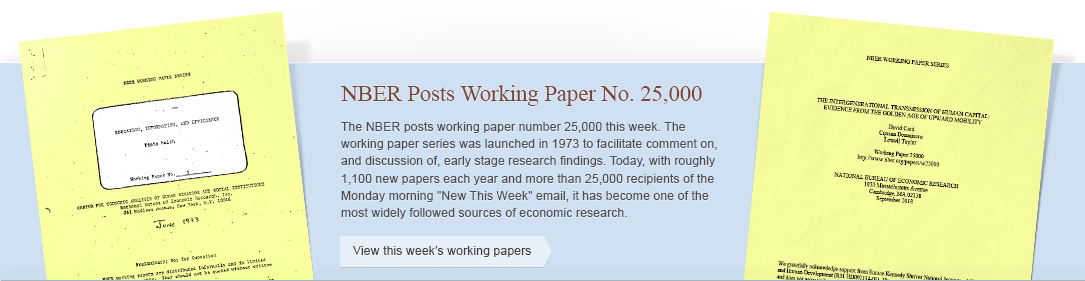
This morning's "New this Week" email included the release of the 25000th NBER working paper, a study of the intergenerational transmission of human capital by David Card, Ciprian Domnisoru, and Lowell Taylor. The NBER working paper series was launched in 1973, at the inspiration of Robert Michael, who sought a way for NBER-affiliated researchers to share their findings and obtain feedback prior to publication. The first working paper was "Education, Information, and Efficiency" by Finis Welch. The design for the working papers -- which many will recall appeared with yellow covers in the pre-digital age -- was created by H. Irving Forman, the NBER's long-serving chart-maker and graphic artist.
Initially there were only a few dozen working papers per year, but as the number of NBER-affiliated researchers grew, particularly after Martin Feldstein became NBER president in 1977, the NBER working paper series also expanded. In recent years, there have been about 1150 papers per year. Over the 45 year history of the working paper series, the Economic Fluctuations and Growth Program has accounted for nearly twenty percent (4916) of the papers, closely followed by Labor Studies (4891) and Public Economics (4877).
Saturday, September 15, 2018
An Open Letter to Tren Griffin
[I tried quite hard to email this privately. I post it here only because Griffin has, as far as I can tell, been very successful in scrubbing his email address from the web. Please forward it to him if you can figure out how.]
Mr. Griffin:
A colleague forwarded me your post, https://25iq.com/2018/09/08/risk-uncertainty-and-ignorance-in-investing-and-business-lessons-from-richard-zeckhauser/. I enjoyed it, and Zeckhauser definitely deserves everyone's highest praise.
However your post misses the bigger picture. Diebold, Doherty, and Herring conceptualized and promoted the "Known, Unknown, Unknowable" (KuU) framework for financial risk management, which runs blatantly throughout your twelve "Lessons From Richard Zeckhauser". Indeed the key Zeckhauser article on which you draw appeared in our book, "The Known, the Unknown and the Unknowable in Financial Risk Management", https://press.princeton.edu/titles/9223.html, which we also conceptualized, and for which we solicited the papers and authors, mentored them as regards integrating their thoughts into the KuU framework, etc. The book was published almost a decade ago by Princeton University Press.
I say all this not only to reveal my surprise and annoyance at your apparent unawareness, but also, and more constructively, because you and your readers may be interested in our KuU book, which has many other interesting parts (great as the Zeckhauser part may be), and which, moreover, is more than the sum of its parts. A pdf of the first chapter has been available for many years at http://assets.press.princeton.edu/chapters/s9223.pdf.
Sincerely,
Thursday, March 8, 2018
H-Index for Journals
In an earlier rant, I suggested that journals move from tracking inane citation "impact factors" to citation "H indexes" or similar, just as routinely done when evaluating individual authors. It turns out that RePEc already does it, here. There are literally many thousands of journals ranked. I show the top 25 below. Interestingly, four "field" journals actually make the top 10, effectively making them "super (uber?) field journals" (J. Finance, J. Financial Economics, J. Monetary Economics, and J. Econometrics). For example, J. Econometrics is basically indistinguishable from Review of Economic Studies.
The rankings
Thursday, November 3, 2016
StatPrize
Check out this new prize, http://statprize.org/ (Thanks, Dave Giles, for informing me via your tweet.) It should be USD 1 Million, ahead of the Nobel, as statistics is a key part (arguably the key part) of the foundation on which every science builds.
And obviously check out David Cox, the first winner. Every time I've given an Oxford econometrics seminar, he has shown up. It's humbling that he evidently thinks he might have something to learn from me. What an amazing scientist, and what an amazing gentleman.
And also obviously, the new StatPrize can't help but remind me of Ted Anderson's recent passing, not to mention the earlier but recent passings, for example, of Herman Wold, Edmond Mallinvaud, and Arnold Zellner. Wow -- sometimes the Stockholm gears just grind too slowly. Moving forward, StatPrize will presumably make such econometric recognition failures less likely.
And obviously check out David Cox, the first winner. Every time I've given an Oxford econometrics seminar, he has shown up. It's humbling that he evidently thinks he might have something to learn from me. What an amazing scientist, and what an amazing gentleman.
And also obviously, the new StatPrize can't help but remind me of Ted Anderson's recent passing, not to mention the earlier but recent passings, for example, of Herman Wold, Edmond Mallinvaud, and Arnold Zellner. Wow -- sometimes the Stockholm gears just grind too slowly. Moving forward, StatPrize will presumably make such econometric recognition failures less likely.
Monday, September 26, 2016
Fascinating Conference at Chicago
I just returned from the University of Chicago conference, "Machine Learning: What's in it for Economics?" Lots of cool things percolating. I'm teaching a Penn Ph.D. course later this fall on aspects of the ML/econometrics interface. Feeling really charged.
By the way, hadn't yet been to the new Chicago economics "cathedral" (Saieh Hall for Economics) and Becker-Friedman Institute. Wow. What an institution, both intellectually and physically.
Tuesday, September 20, 2016
On "Shorter Papers"
Journals should not corral shorter papers into sections like "Shorter Papers". Doing so sends a subtle (actually unsubtle) message that shorter papers are basically second-class citizens, somehow less good, or less important, or less something -- not just less long -- than longer papers. If a paper is above the bar, then it's above the bar, and regardless of its length it should then be published simply as a paper, not a "shorter paper", or a "note", or anything else. Many shorter papers are much more important than the vast majority of longer papers.
Tuesday, September 6, 2016
Inane Journal "Impact Factors"
Why are journals so obsessed with "impact factors"? (The five-year impact factor is average citations/article in a five-year window.) They're often calculated to three decimal places, and publishers trumpet victory when they go from (say) 1.225 to 1.311! It's hard to think of a dumber statistic, or dumber over-interpretation. Are the numbers after the decimal point anything more than noise, and for that matter, are the numbers before the decimal much more than noise?
Why don't journals instead use the same citation indexes used for individuals? The leading index seems to be the h-index, which is the largest integer h such that an individual has h papers, each cited at least h times. I don't know who cooked up the h-index, and surely it has issues too, but the gurus love it, and in my experience it tells the truth.
Even better, why not stop obsessing over clearly-insufficient statistics of any kind? I propose instead looking at what I'll call a "citation signature plot" (CSP), simply plotting the number of cites for the most-cited paper, the number of cites for the second-most-cited paper, and so on. (Use whatever window(s) you want.) The CSP reveals everything, instantly and visually. How high is the CSP for the top papers? How quickly, and with what pattern, does it approach zero? etc., etc. It's all there.
Google-Scholar CSP's are easy to make for individuals, and they're tremendously informative. They'd be only slightly harder to make for journals. I'd love to see some.
Why don't journals instead use the same citation indexes used for individuals? The leading index seems to be the h-index, which is the largest integer h such that an individual has h papers, each cited at least h times. I don't know who cooked up the h-index, and surely it has issues too, but the gurus love it, and in my experience it tells the truth.
Even better, why not stop obsessing over clearly-insufficient statistics of any kind? I propose instead looking at what I'll call a "citation signature plot" (CSP), simply plotting the number of cites for the most-cited paper, the number of cites for the second-most-cited paper, and so on. (Use whatever window(s) you want.) The CSP reveals everything, instantly and visually. How high is the CSP for the top papers? How quickly, and with what pattern, does it approach zero? etc., etc. It's all there.
Google-Scholar CSP's are easy to make for individuals, and they're tremendously informative. They'd be only slightly harder to make for journals. I'd love to see some.
Monday, August 8, 2016
NSF Grants vs. Improved Data
Lots of people are talking about the Cowen-Tabarrok Journal of Economic Perspectives piece, "A Skeptical View of the National Science Foundation’s Role in Economic Research". See, for example, John Cochrane's insightful "A Look in the Mirror".
A look in the mirror indeed. I was a 25-year ward of the NSF, but for the past several years I've been on the run. I bolted in part because the economics NSF reward-to-effort ratio has fallen dramatically for senior researchers, and in part because, conditional on the ongoing existence of NSF grants, I feel strongly that NSF money and "signaling" are better allocated to young assistant and associate professors, for whom the signaling value from NSF support is much higher.
Cowen-Tabarrok make some very good points. But I can see both sides of many of their issues and sub-issues, so I'm not taking sides. Instead let me make just one observation (and I'm hardly the first).
If NSF funds were to be re-allocated, improved data collection and dissemination looks attractive. I'm not talking about funding cute RCTs-of-the-month. Rather, I'm talking about funding increased and ongoing commitment to improving our fundamental price and quantity data (i.e., the national accounts and related statistics). They desperately need to be brought into the new millennium. Just look, for example, at the wealth of issues raised in recent decades by the Conference on Research in Income and Wealth.
Ironically, it's hard to make a formal case (at least for data dissemination as opposed to creation), as Chris Sims has emphasized with typical brilliance. His "The Futility of Cost-Benefit Analysis for Data Dissemination" explains "why the apparently reasonable idea of applying cost-benefit analysis to government programs founders when applied to data dissemination programs." So who knows how I came to feel that NSF funds might usefully be re-allocated to data collection and dissemination. But so be it.
Cowen-Tabarrok make some very good points. But I can see both sides of many of their issues and sub-issues, so I'm not taking sides. Instead let me make just one observation (and I'm hardly the first).
If NSF funds were to be re-allocated, improved data collection and dissemination looks attractive. I'm not talking about funding cute RCTs-of-the-month. Rather, I'm talking about funding increased and ongoing commitment to improving our fundamental price and quantity data (i.e., the national accounts and related statistics). They desperately need to be brought into the new millennium. Just look, for example, at the wealth of issues raised in recent decades by the Conference on Research in Income and Wealth.
Ironically, it's hard to make a formal case (at least for data dissemination as opposed to creation), as Chris Sims has emphasized with typical brilliance. His "The Futility of Cost-Benefit Analysis for Data Dissemination" explains "why the apparently reasonable idea of applying cost-benefit analysis to government programs founders when applied to data dissemination programs." So who knows how I came to feel that NSF funds might usefully be re-allocated to data collection and dissemination. But so be it.
Sunday, July 10, 2016
Contemporaneous, Independent, and Complementary
You've probably been in a situation where you and someone else discovered something "contemporaneously and independently". Despite the initial sinking feeling, I've come to realize that there's usually nothing to worry about.
First, normal-time science has a certain internal momentum -- it simply must evolve in certain ways -- so people often identify and pluck the low-hanging fruit more-or-less simultaneously.
Second, and crucially, such incidents are usually not just the same discovery made twice. Rather, although intimately-related, the two contributions usually differ in subtle but important ways, rendering them complements, not substitutes.
Here's a good recent example in financial econometrics, working out asymptotics for high-frequency high-dimensional factor models. On the one hand, consider Pelger, and on the other hand consider Ait-Sahalia and Xiu. There's plenty of room in the world for both, and the whole is even greater than the sum of the (individually-impressive) parts.
First, normal-time science has a certain internal momentum -- it simply must evolve in certain ways -- so people often identify and pluck the low-hanging fruit more-or-less simultaneously.
Second, and crucially, such incidents are usually not just the same discovery made twice. Rather, although intimately-related, the two contributions usually differ in subtle but important ways, rendering them complements, not substitutes.
Here's a good recent example in financial econometrics, working out asymptotics for high-frequency high-dimensional factor models. On the one hand, consider Pelger, and on the other hand consider Ait-Sahalia and Xiu. There's plenty of room in the world for both, and the whole is even greater than the sum of the (individually-impressive) parts.
Sunday, May 8, 2016
Safe Assets
Gary Gorton has a fascinating new paper, "History and Economics of Safe Assets", which contains the quote of the week: "...almost all of human history can be written as the search for and the production of different forms of safe assets". Not sure that's the first cut I'd take at "all of human history", but it's certainly an interesting perspective. As the old maxim says: "When you have a hammer, everything looks like a nail".
Friday, March 11, 2016
Miserable Teaching Evaluations
I have always disliked teaching evaluations, feeling that they fail to measure true teaching effectiveness. And it's not just sour grapes -- really, I swear, I generally do fine and have won several teaching awards. Rather, I simply think that teaching evaluations create bad incentives. Ask yourself: Is the behavior that maximizes teaching evaluations the same behavior that maximizes true teaching effectiveness? No way.
But it may be much worse than that. Check out the abstract below for a seminar to be presented in Penn Statistics next week by Philip Stark, a Berkeley statistician (and Associate Dean of the Division of Mathematical and Physical Sciences). Paper here.

But it may be much worse than that. Check out the abstract below for a seminar to be presented in Penn Statistics next week by Philip Stark, a Berkeley statistician (and Associate Dean of the Division of Mathematical and Physical Sciences). Paper here.
TEACHING EVALUATIONS (MOSTLY) DO NOT MEASURE TEACHING EFFECTIVENESS

PHILIP STARK - UNIVERSITY OF CALIFORNIA, BERKELEY
Joint work with Anne Boring (SciencesPo) and Kellie Ottoboni (UC Berkeley)
Student evaluations of teaching (SET) are widely used in academic personnel decisions as a measure of teaching effectiveness. We show:
· SET are biased against female instructors by an amount that is large and statistically significant
· the bias affects how students rate even putatively objective aspects of teaching, such as how promptly assignments are graded
· the bias varies by discipline and by student gender, among other things
· it is not possible to adjust for the bias, because it depends on so many factors
· SET are more sensitive to students' gender bias and grade expectations than they are to teaching effectiveness
· gender biases can be large enough to cause more effective instructors to get lower SET than less effective instructors.
These findings are based on permutation tests applied to two datasets: 23,001 SET of 379 instructors by 4,423 students in six mandatory first-year courses in a five-year natural experiment at a French university, and 43 SET for four sections of an online course in a randomized, controlled, blind experiment at a US university.
Tuesday, March 1, 2016
Yes, Science *Does* Advance One Funeral at a Time
Fascinating research, as reported in the March 2016 NBER Reporter:
Does Science Advance One Funeral at a Time?
When a star scientist dies, outsiders often tackle mainstream questions in the field by leveraging new ideas that arise in other domains.
Knowledge accumulation — the process by which new research builds upon prior research — is central to scientific progress, but the way this process works is not well understood.
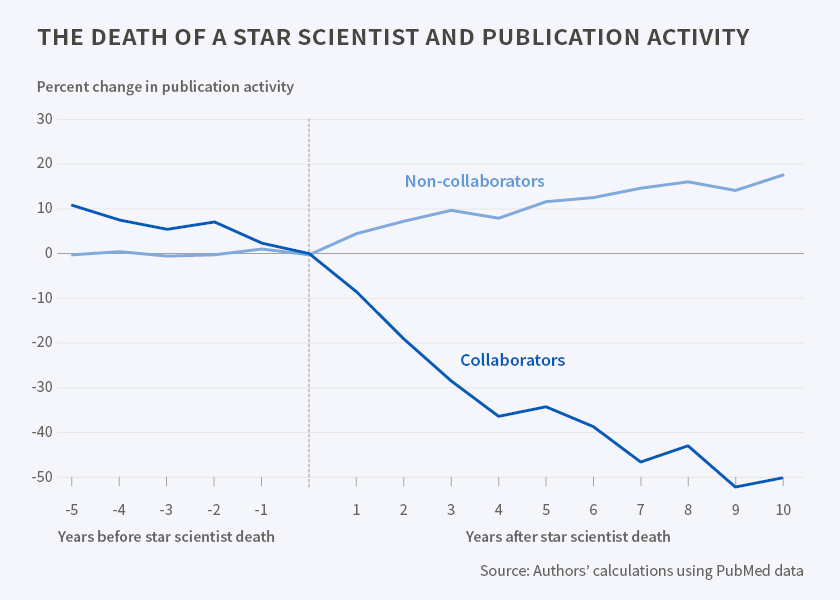
In Does Science Advance One Funeral at a Time? (NBER Working Paper No. 21788), Pierre Azoulay, Christian Fons-Rosen, and Joshua S. Graff Zivin explore the famous quip by physicist Max Planck. They show that the premature deaths of elite scientists affect the dynamics of scientific discovery. Following such deaths, scientists who were not collaborators with the deceased stars become more visible, and they advance novel ideas through increased publications within the field of the deceased star. These "emerging stars" are often scientists who were not previously active within that field. The results suggest that outsiders to a specific scientific field are reluctant to challenge a research star who is viewed as a leader within that field.
The authors tracked the publication records of scientists — both collaborators and non-collaborators — before and after a "research superstar" died. To narrow the scope of their study, they focused on academics in the life sciences, a sector which is heavily supported by National Institutes of Health funding and produces a high volume of research. They established a list of 12,935 elite scientists using criteria such as the amount of research funding received, publication citations, number of patents, membership in prestigious organizations, and career awards and prizes. They then examined records of 452 of those elite scientists who died prematurely — before retiring or becoming administrators — between 1975 and 2003. Publication data was gathered from the National Library of Medicine's PubMed service, which indexes and tracks articles by research topics, names of authors and coauthors, citations, related articles, and other information from 40,000 publications.
The findings confirm previous work showing that the number of articles by collaborators decreased substantially — by about 40 percent — after the death of a star scientist. Publication activity by non-collaborators increased by an average of 8 percent after the death of an elite scientist. By five years after the death, this activity of non-collaborators fully offset the productivity decline of collaborators. "These additional contributions are disproportionately likely to be highly cited," the researchers found. "They are also more likely to be authored by scientists who were not previously active in the deceased superstar's field."
Few of the deceased scientists served as editors of academic journals or on committees overseeing the issuance of research grants, so the researchers rule out the possibility that the deceased scientists used their influence to limit who could or could not publish their work or receive grants within their field. Instead, they say, the evidence suggests that outsiders were reluctant to challenge the leadership within research areas in which an elite scientist was active. While entry occurs after a star's passing, it is not monolithic. Key collaborators left behind can regulate entry into the field through the control of intellectual, social, and resource barriers.
"While coauthors suffer after the passing of a superstar, it is not simply the case that star scientists in a competing lab assume the leadership mantle," the authors conclude. "Rather, the boost comes largely from outsiders who appear to tackle the mainstream questions within the field but by leveraging newer ideas that arise in other domains. This intellectual arbitrage is quite successful — the new articles represent substantial contributions, at least as measured by long-run citation impact."
—Jay Fitzgerald
Monday, January 11, 2016
Brilliant Strategy and Stunning Results
Check out Justin Wolfers' latest:
From The New York Times: “When
Teamwork Doesn’t Work for Women”
A study finds that female economists get far less credit for collaborative work than their male colleagues do, often harming their career prospects.
http://www.nytimes.com/2016/01/10/upshot/when-teamwork-doesnt-work-for-women.html?mwrsm=Email
A study finds that female economists get far less credit for collaborative work than their male colleagues do, often harming their career prospects.
http://www.nytimes.com/2016/01/10/upshot/when-teamwork-doesnt-work-for-women.html?mwrsm=Email
I am simply blown away.
I haven't yet read the underlying new paper by Heather Sarsons, but I look forward to it.
Monday, December 28, 2015
Cochrane on Research Reliability and Replication
Check out John's new piece. His views largely match mine. Here's to the demand side!
Sunday, September 27, 2015
Near Writing Disasters
Check this out this "Retraction Watch" post, forwarded by a reader:
http://retractionwatch.com/2014/11/11/overly-honest-references-should-we-cite-the-crappy-gabor-paper-here/
Really funny. Except that it's a little close to home. I suspect that we've all had a few such accidents, or at least near-accidents, and with adjectives significantly stronger than "crappy". I know I have.
http://retractionwatch.com/2014/11/11/overly-honest-references-should-we-cite-the-crappy-gabor-paper-here/
Really funny. Except that it's a little close to home. I suspect that we've all had a few such accidents, or at least near-accidents, and with adjectives significantly stronger than "crappy". I know I have.
Thursday, September 10, 2015
The Econ Ph.D. Placement Network
Speaking of interesting applications of network connectedness measures, check out Ricky Vohra's latest post in Leisure of the Theory Class. It reports on a fascinating paper by Chu Kin ("Roy") Chan, a talented undergrad who visited Penn for the past year. Congratulations Roy!
Saturday, August 29, 2015
New CEA Overview of GDO
The U.S. Council of Economic Advisors has a nice new review of "Gross Domestic Output" (GDO), a simple average of expenditure- and income-side GDP estimates now published by the BEA.
In an earlier post I wrote rather negatively about GDO as compared to GDPplus, which is an optimally-weighted blend rather than a simple average. (See the FRB Philadelphia GDPplus site and the corresponding Aruba et al. paper available there.) My view has not changed.
But I want to be very clear about one thing: Quite apart from whether GDO is as accurate as GDPplus, GDO is surely much, much more accurate than standard expenditure-side GDP alone, or income-side GDP alone. Just look at Figure 2 and the surrounding discussion here. (in X. Chen and N. Swanson, eds., Causality, Prediction, and Specification Analysis: Recent Advances and Future Directions, Essays in Honor of Halbert L. White Jr., Springer, 2013, 1-26).
As I said in the above-mentioned earlier post (but alas, burried at the end):
[By the way, speaking of the Hal White volume, the introductory chapter is marvelous, filled with wonderful memories of Hal's career and insights into his research. You must read his description of his career path leading to UCSD, pp. vii-xi in the gray box.]
In an earlier post I wrote rather negatively about GDO as compared to GDPplus, which is an optimally-weighted blend rather than a simple average. (See the FRB Philadelphia GDPplus site and the corresponding Aruba et al. paper available there.) My view has not changed.
But I want to be very clear about one thing: Quite apart from whether GDO is as accurate as GDPplus, GDO is surely much, much more accurate than standard expenditure-side GDP alone, or income-side GDP alone. Just look at Figure 2 and the surrounding discussion here. (in X. Chen and N. Swanson, eds., Causality, Prediction, and Specification Analysis: Recent Advances and Future Directions, Essays in Honor of Halbert L. White Jr., Springer, 2013, 1-26).
As I said in the above-mentioned earlier post (but alas, burried at the end):
I applaud the BEA's new averaged GDP. If it's not at the cutting edge, it's nevertheless much superior to the standard approach of doing nothing ... and it's an official acknowledgment of the wastefulness of doing so. Hence it's a significant step in the right direction. Hopefully its publication by BEA will nudge people away from uncritical and exclusive reliance on expenditure-side GDP.So here's to GDO.
[By the way, speaking of the Hal White volume, the introductory chapter is marvelous, filled with wonderful memories of Hal's career and insights into his research. You must read his description of his career path leading to UCSD, pp. vii-xi in the gray box.]
Monday, August 24, 2015
The Superiority of Economists
The title of this post is the title of a newish paper by Marion Fourcade (Berkeley), Etienne Ollion (Strasbourg), and Yann Algan (Sciences Po, Paris) (FOA).
Yes, I know FOA is already published, even insightfully blogged by Krugman. (Blogged on? Blogged upon? Or maybe give up and just say "reviewed"?) But I'm often slow to notice things; maybe you are too. So if you haven't read it yet, take a look. Regardless of your reaction, it's undeniably fascinating reading.
FOA popped back into my head because I recently received an email announcing its September 2015 presentation at the 20th Anniversary Conference of the Foundation Banque de France, with discussion by Ramon Marimon (EUI) and Lucrezia Reichlin (LBS).
It's interesting that FOA is still being presented after publication, which is highly unusual in economics. But it makes sense: it's a unique paper, and there's still a lot to discuss.
Yes, I know FOA is already published, even insightfully blogged by Krugman. (Blogged on? Blogged upon? Or maybe give up and just say "reviewed"?) But I'm often slow to notice things; maybe you are too. So if you haven't read it yet, take a look. Regardless of your reaction, it's undeniably fascinating reading.
FOA popped back into my head because I recently received an email announcing its September 2015 presentation at the 20th Anniversary Conference of the Foundation Banque de France, with discussion by Ramon Marimon (EUI) and Lucrezia Reichlin (LBS).
It's interesting that FOA is still being presented after publication, which is highly unusual in economics. But it makes sense: it's a unique paper, and there's still a lot to discuss.
Subscribe to:
Posts (Atom)